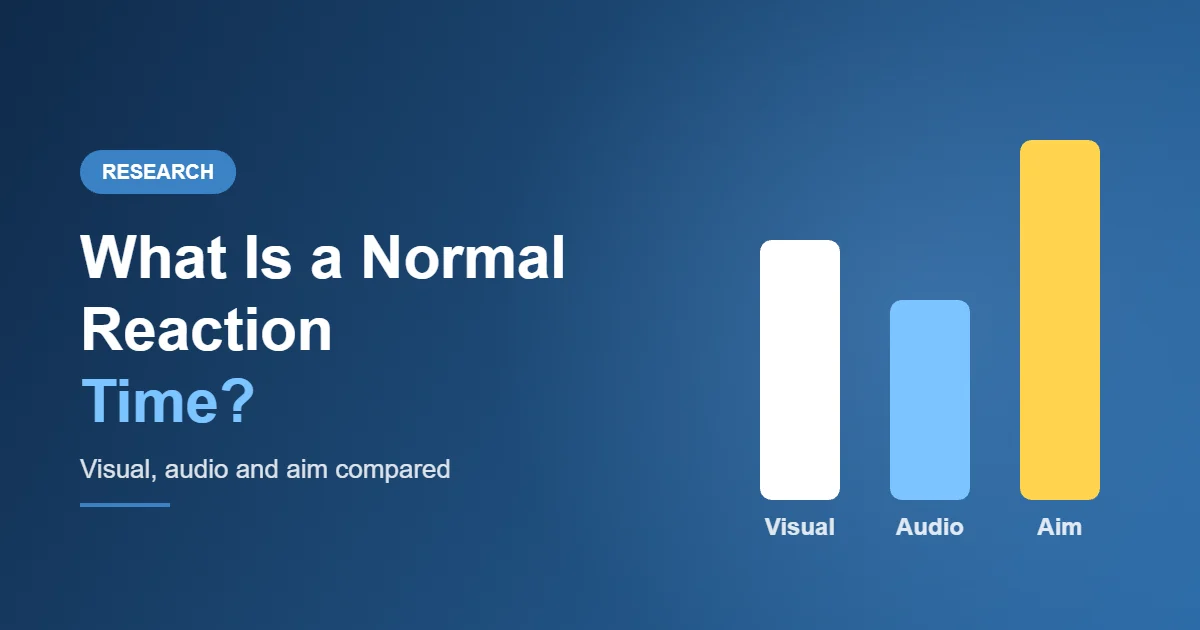
Ask ten people what a normal reaction time is and you will hear ten different numbers. That is because "normal" depends on what you are reacting to and how it is measured.
Reacting to a colour change, a beep or a target you have to aim at are three very different tasks. Each one has its own normal range. This guide breaks them down so you can understand your own scores.
Want your own numbers first? Try the free visual test, audio test and reflex game.
Key takeaways
- A large 2015 study found an average simple visual reaction time of 231 ms in adults aged 18 to 65.
- Most adults score around 250 to 300 ms on an online visual test, because devices add delay.
- People usually react faster to sound than to light.
- Aiming tasks take much longer, often several hundred milliseconds per target.
- Compare scores only on the same type of test and the same device.
Normal Visual Reaction Time
Visual reaction time is how fast you respond to something you see, like a screen turning green. It is the most common type of reaction test.
A 2015 study by Woods and colleagues tested 1,469 adults aged 18 to 65 on a carefully calibrated test. The average simple reaction time was 231 ms, or 213 ms after correcting for hardware delays. Reaction time also got slower with age.
Online tests usually show higher numbers. Your screen, mouse and browser all add delay. That is why on VoltReflex, 250 to 300 ms is typical for a healthy adult and under 200 ms is excellent. See the full ranges on our reaction time benchmarks page.
Normal Audio Reaction Time
Auditory reaction time is how fast you respond to a sound. In most studies, it is faster than visual reaction time.
A 2015 study by Jain and colleagues tested 120 medical students and found that reaction to a sound was faster than reaction to a light in both men and women. Our post on visual vs auditory reaction time explains why.
Online, your speakers or headphones add their own delay, and Bluetooth can add a lot. So the best way to judge your audio score is to compare it with your own visual score on the same device.
Normal Aim Reaction Time
When you have to move to a target and click it, you add aiming to the task. Psychologist Paul Fitts showed in 1954 that aimed movements take longer when targets are smaller or farther away.
That is why aim scores are much slower than simple reaction scores. In the VoltReflex reflex game, an average of 600 to 749 ms per Normal-size target is rated Average, and under 400 ms is rated Superhuman. These bands are our own guide, not a scientific standard. Learn more in Fitts law explained.
| Test type | What it measures | What is normal |
|---|---|---|
| Visual simple reaction | Click when the screen changes | About 250 to 300 ms online |
| Audio simple reaction | Click when you hear a beep | Usually faster than your visual score |
| Choice reaction | Pick the right response first | Slower than simple reaction |
| Aim and click | Find, move to and hit a target | About 600 to 750 ms per target |
Choice reaction, where you must decide between options, is slower again. Read choice vs simple reaction time for the details.
Test yourself Take all three tests in one session, the visual test, the audio test and the reflex game. Write down each average and repeat in a week to track your progress.
Why Your Device Changes What Is Normal
A 2021 study in Behavior Research Methods used a robot to press keys on different computers and browsers. The delay between the real press and the recorded press was often around 60 to 120 ms, depending on the setup.
So a score that looks slow may partly be your hardware. A high refresh rate screen, a wired mouse and a fast browser all help. See monitor refresh rate and mobile vs PC reaction time.
What Else Shifts Your Normal
- Age. Reaction time slowly rises with age. See average reaction time by age.
- Sleep and fatigue. Tiredness slows you down and adds slow outliers.
- Practice. Most people get a little faster with regular testing.
- Time of day and caffeine. Both can shift your score by a noticeable amount.
If your score feels too slow, read why your reaction time might be slow. For a score-by-score guide, see is 200 ms reaction time good.
Frequently Asked Questions
What is a normal reaction time?
Is 250 ms a normal reaction time?
Is audio reaction time faster than visual?
Why is my aim score so much slower?
How can I check if my reaction time is normal?
The Bottom Line
There is no single normal reaction time. A calibrated lab test gives adults an average of around 231 ms, online visual tests usually land at 250 to 300 ms, sound is usually faster and aiming is much slower.
The best benchmark is you. Take the free VoltReflex tests on the same device each time and track how your own averages change.
VoltReflex results are for entertainment and self-benchmarking, not a medical diagnosis.
Sources
- Woods et al. (2015), Factors influencing the latency of simple reaction time, Frontiers in Human Neuroscience
- Jain et al. (2015), A comparative study of visual and auditory reaction times, International Journal of Applied and Basic Medical Research
- Fitts (1954), The information capacity of the human motor system in controlling the amplitude of movement, Journal of Experimental Psychology
- Anwyl-Irvine et al. (2021), Realistic precision and accuracy of online experiment platforms, web browsers, and devices, Behavior Research Methods