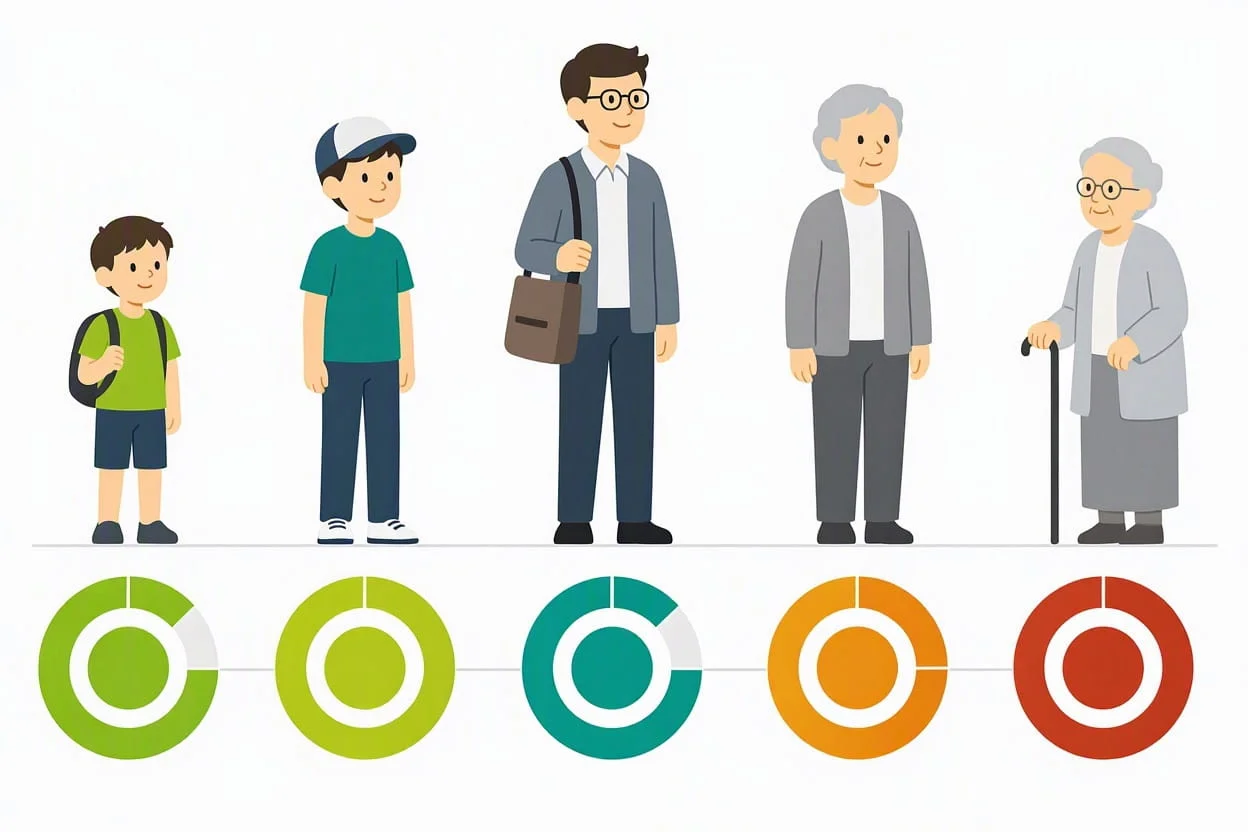
Your reaction time is not static throughout life. It follows a predictable developmental curve — improving steadily through childhood, peaking in the early-to-mid 20s, and gradually declining from there. Understanding this curve helps you interpret your own test results and set realistic expectations for performance at your age.
The Reaction Time Lifecycle
Research from multiple large-scale studies paints a consistent picture of how visual reaction time evolves across the human lifespan. The key findings are summarised below.
| Age Group | Average Reaction Time | Key Characteristic | Trend |
|---|---|---|---|
| Children (6–9) | 400 – 600 ms | Neural pathways still developing; high variability | ↓ Improving rapidly |
| Pre-teens (10–12) | 350 – 450 ms | Significant myelination occurring; faster each year | ↓ Improving |
| Teenagers (13–17) | 250 – 320 ms | Major developmental leap; adult-like performance emerging | ↓ Improving fast |
| Young adults (18–24) | 190 – 230 ms | Peak performance window; fastest average reaction times | → Peak |
| Adults (25–30) | 200 – 250 ms | Near-peak; subtle decline just beginning | ↗ Very slight rise |
| Adults (31–40) | 230 – 270 ms | Gradual ~1–2 ms/year decline; barely noticeable | ↑ Slow rise |
| Adults (41–55) | 260 – 310 ms | Moderate decline; exercise significantly offsets this | ↑ Rising |
| Older adults (56–65) | 300 – 380 ms | More pronounced slowing; higher trial-to-trial variability | ↑ Rising |
| Seniors (65+) | 380 – 550 ms | Significant neural slowing; large individual differences | ↑ Rising |
Important context: These are population averages from research studies. Individual variation is enormous — a physically active 65-year-old often outperforms a sedentary 30-year-old. Age is a factor, not a destiny.
Why Do Children React More Slowly?
Children's slower reaction times are primarily due to incomplete neural development. The brain undergoes a process called myelination — the coating of nerve fibres with myelin, a fatty substance that dramatically increases the speed of electrical signals. Myelination of the pathways involved in visual processing and motor response continues well into the mid-20s.
Additionally, children's attention systems are less developed, meaning they're more susceptible to distraction and take longer to lock focus onto a stimulus. Their inhibitory control — the ability to suppress premature responses — is also still maturing, leading to higher variability between attempts.
The Peak Years: 18–24
Research consistently identifies the late teens to mid-20s as the peak window for reaction time. By this age, myelination of primary neural pathways is largely complete, the prefrontal cortex (responsible for decision-making) reaches maturity, and aerobic capacity — which supports cerebral blood flow — is typically at its lifetime high.
Studies of professional esports players, who are disproportionately in this age bracket, show average reaction times of 140–180 ms — significantly faster than the population average — suggesting that peak neural machinery combined with intensive practice produces the fastest human reaction times achievable.
Why Does Reaction Time Slow With Age?
From the late 20s onward, reaction time increases at roughly 1–2 ms per year under typical conditions. Several biological mechanisms drive this decline:
- Myelin degradation: Myelin sheaths gradually thin over time, slightly reducing neural conduction velocity across all pathways.
- Reduced cerebral blood flow: Cardiovascular efficiency naturally decreases with age, delivering slightly less oxygen and glucose to the brain per unit time.
- Neurotransmitter changes: Levels of dopamine and acetylcholine — key neurotransmitters for fast neural signalling — decline with age, slowing synaptic transmission.
- Increased neural noise: Older brains show higher "background noise" in neural activity, making it harder to quickly detect and respond to a clear signal.
- Greater decision complexity: As we age, we become more cautious and accuracy-focused, taking fractionally longer to initiate a response to ensure correctness.
The Good News: Age Is Not Destiny
Perhaps the most important finding in the research on age and reaction time is how dramatically lifestyle factors can modify the age-related decline. Several interventions are supported by strong evidence:
- Regular aerobic exercise — the most powerful counterweight to age-related cognitive slowing. Active older adults consistently outperform sedentary peers by 50–100 ms.
- Strength training — associated with improved processing speed and reaction time in adults over 50.
- Continued cognitive stimulation — learning new skills, playing musical instruments, gaming — all help maintain neural plasticity.
- Quality sleep — adults over 50 who consistently get 7–8 hours show significantly less age-related reaction time decline than poor sleepers.
- Mediterranean diet — associated with slower cognitive decline and faster processing speed in multiple longitudinal studies.
How to Interpret Your VoltReflex Score at Your Age
When reviewing your reaction time result, compare it within your age bracket rather than against the absolute average. A 55-year-old scoring 280 ms is performing at an excellent level for their age group, even though that score sits in the "average" band for 25-year-olds.
Use the VoltReflex benchmark page for general skill-level comparisons, and track your own trend over time as the most meaningful indicator of your personal trajectory.
Take the test: Measure your baseline at voltreflex.com and track your results weekly to see your personal trend over time.