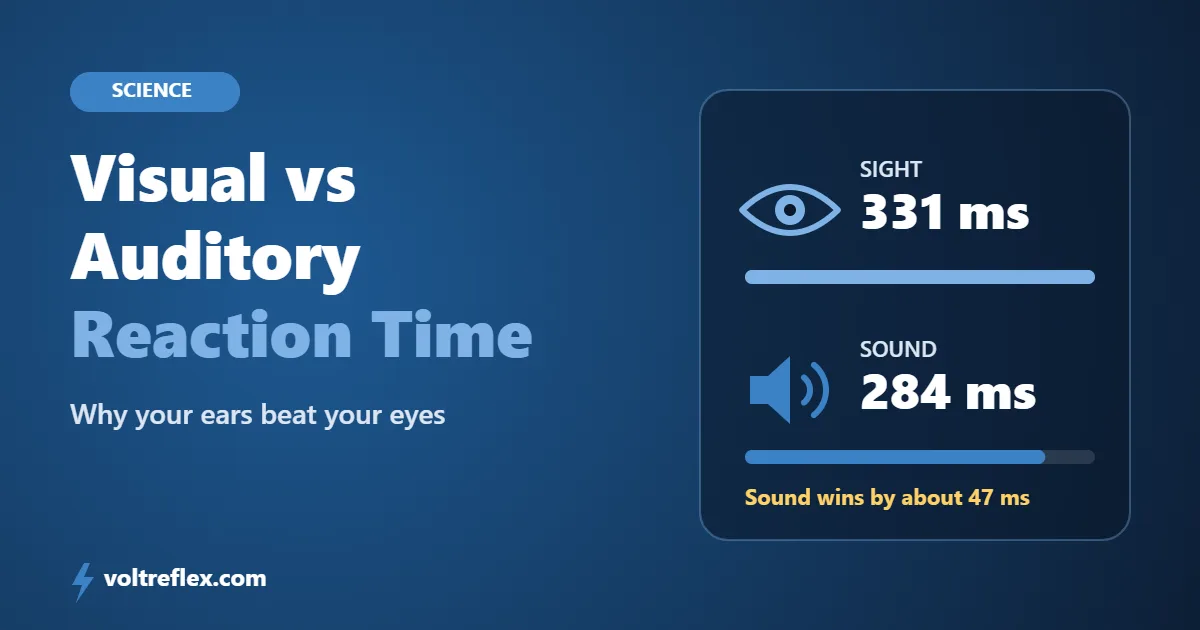
Here is something most people never notice. You react to a sound faster than you react to something you see.
In visual vs auditory reaction time studies, sound usually wins by around 40 to 50 ms. That gap is bigger than the difference between a 60 Hz and a 240 Hz monitor.
Want your own number first? Take the free VoltReflex reaction time test. It measures the visual side.
Key takeaways
- Auditory reaction time is typically 40 to 50 ms faster than visual.
- Sound reaches the brain in about 8 to 10 ms. Light takes 20 to 40 ms.
- Most adults score 250 to 300 ms on an online visual test.
- Exercise and practice speed up both. Age mostly slows the movement part, not detection.
Visual vs Auditory Reaction Time in Numbers
Different labs get different results, because the equipment and the task change the number. The gap between sight and sound stays fairly steady though.
| Source | Visual | Auditory | Gap |
|---|---|---|---|
| Older studies cited by Shelton and Kumar | 180 to 200 ms | 140 to 160 ms | About 40 ms |
| Shelton and Kumar (2010) | About 331 ms | About 284 ms | About 47 ms |
| Typical online visual test | 250 to 300 ms | Not measured | Device delay adds time |
The 2010 figures come from a small study in Neuroscience and Medicine, so treat them as a guide, not a rule. The direction of the result matches decades of earlier work.
Why Sound Beats Sight
It comes down to how fast each signal gets into your brain.
Your ear turns sound into a nerve signal almost directly. Your eye has to run light through a chemical reaction in the retina first, and that takes longer.
That early head start of 10 to 30 ms carries through every later step. Your brain still has to notice the signal, decide, and send a command to your hand.
A large study of 1,469 adults estimated that just detecting a visual signal takes about 131 ms. The rest of a simple reaction is the movement itself.
"Your ears get a head start before your brain even begins to decide. That is why a starting gun works better than a flashing light."
What Else Changes Your Result
Exercise
A study of 120 medical students in the International Journal of Applied and Basic Medical Research found regular exercisers reacted faster than sedentary students, for both sound and sight.
Sex
The same student study found men faster on both tests. But the much larger 1,469 person study found no real difference by sex. Small groups can exaggerate gaps that are not really there.
Age
Reaction time slows slowly, about 0.55 ms per year. Interestingly, the large study found the detection part stayed stable with age. The slowdown was mostly in the movement.
See the full picture in average reaction time by age.
Your device
Screens, mice and browsers all add delay to a visual test. When the same researchers corrected for hardware delay, the average dropped from 231 ms to 213 ms.
We explain this in how accurate online reaction time tests are.
What It Means for Gamers
Sound is your fastest early warning. Footsteps, reloads and ability cues can tell you what is coming before it shows on screen.
- Use a decent headset so you can tell where sounds come from.
- Keep game audio clear. Turn music down so key cues stand out.
- Train the visual side too. Most aiming still depends on what you see.
Research on action video games and processing speed suggests regular players get faster without losing accuracy. For more practical tips, read how pro players train their reflexes.
Test yourself Run a 10 round visual reaction time test and note your average. Compare it with the reaction time benchmarks to see where you stand.
What It Means for Sprinters
Races start with a gun for a reason. Sound gets athletes moving faster than a light would.
Even so, there is a floor. World Athletics treats any reaction under 100 ms as a false start, because a real response to the gun is not believed to be possible that quickly.
Do not guess the start In a test or a race, anticipating the signal can look fast but it is not a real reaction. Wait for the screen to change before you click, or your score means nothing.
How to Get Faster at Both
- Sleep well. Tiredness slows every part of the chain. Read more in sleep and reaction time.
- Move your body. Regular exercise is linked to faster responses.
- Practise a little every day. Ten minutes of focused testing beats one long session.
- Remove distractions. Split attention slows both sight and sound responses.
For a full plan, see how to improve reaction time.
Frequently Asked Questions
Is auditory reaction time faster than visual?
Why do we react faster to sound?
What is a good visual reaction time?
Are men faster than women at reacting?
Does VoltReflex test visual or auditory reaction time?
Can gaming improve reaction time?
The Bottom Line
In the visual vs auditory reaction time contest, sound wins by roughly 40 to 50 ms. The reason is simple. Sound signals reach your brain sooner.
Visual reactions are slower but they are what you rely on to read a screen. So test your visual reaction time, track it over a few weeks, and see how sleep and practice move the number.
VoltReflex results are for entertainment and self-benchmarking, not a medical diagnosis.
Sources
- Shelton and Kumar (2010), Comparison between Auditory and Visual Simple Reaction Times
- Woods et al. (2015), Factors influencing the latency of simple reaction time
- Jain et al. (2015), Visual and auditory reaction times by gender and physical activity
- Dye, Green and Bavelier (2009), Increasing Speed of Processing With Action Video Games