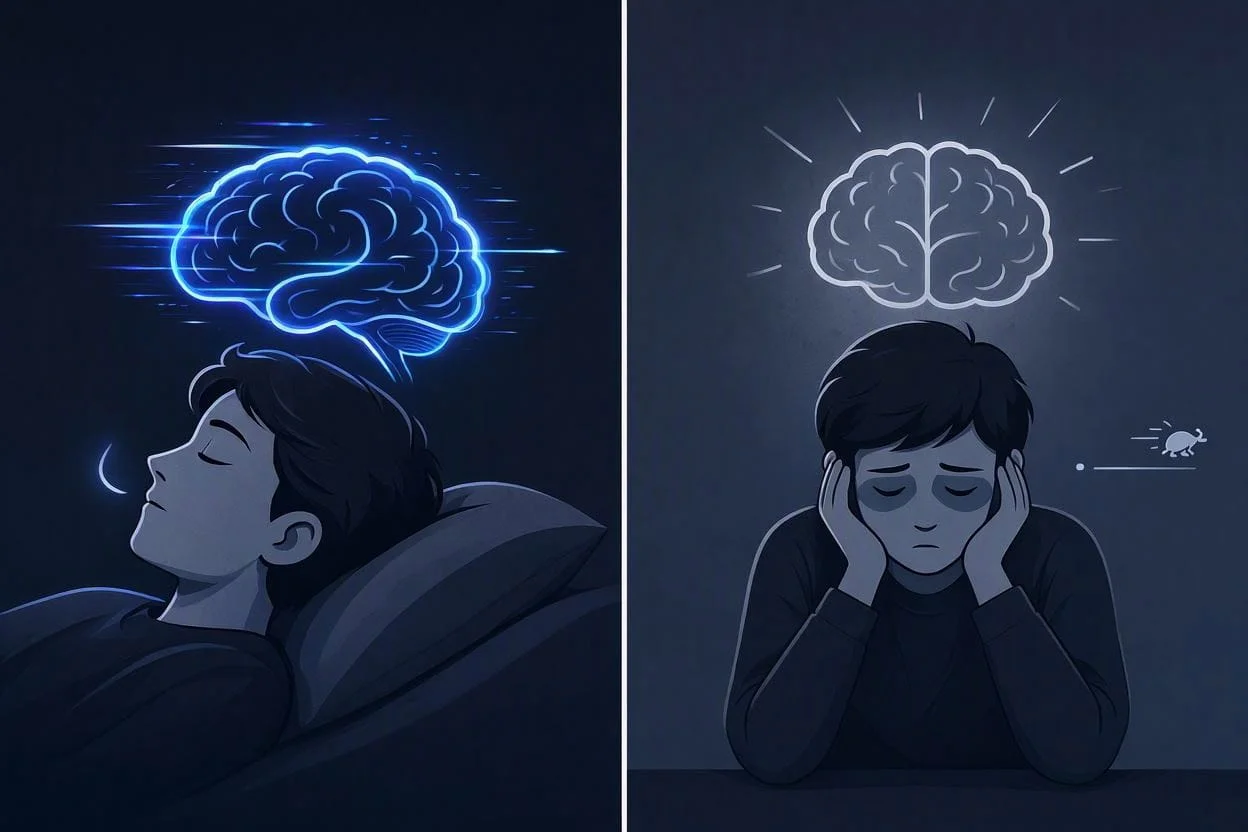
You can spend weeks optimising your gaming setup, practising daily aim drills, and eating well — but if you skimp on sleep, all of that effort is undermined in a single night. Sleep deprivation is the single most impactful factor affecting human reaction time, and the research is unambiguous about just how damaging it is.
In this article we break down exactly what sleep does to your reflexes, what happens at each level of sleep loss, and the most effective strategies to protect and recover your reaction speed.
"24 hours without sleep produces reaction time impairment equivalent to a blood-alcohol level of 0.10% — above the legal driving limit in most countries."
The Numbers: How Much Does Sleep Cost?
The relationship between sleep and reaction time is dose-dependent — the less sleep you get, the worse your reflexes become. Here is what the data shows:
| Sleep Amount | Typical RT Impact | Equivalent To | Status |
|---|---|---|---|
| 8–9 hours (optimal) | Baseline — peak performance | Fully rested brain | Optimal |
| 7 hours | ~5–10 ms slower | Minimal impact | Good |
| 6 hours | ~15–25 ms slower | Slight but measurable impairment | Fair |
| 5 hours | ~30–50 ms slower | Moderate impairment | Poor |
| 4 hours or less | ~50–100 ms slower | Significant impairment | Severe |
| 24h awake | ~100–150 ms slower | BAC of 0.10% | Dangerous |
To put that in perspective: a well-rested gamer scoring 200 ms on VoltReflex after a poor night's sleep could easily score 280–300 ms — dropping from "Excellent" to "Below Average" without any change in skill or hardware.
The drunk driving comparison Research by Williamson & Feyer (2000) found that 17–19 hours awake produces impairment equivalent to a 0.05% BAC, and 24 hours awake equals 0.10% BAC. Most countries set the legal driving limit at 0.05–0.08%. You would not drink and drive — but millions of people drive just as impaired from sleep loss every day.
Why Sleep Deprivation Destroys Reaction Time
Sleep deprivation damages reaction time through several interconnected biological mechanisms:
1. Adenosine Buildup
During waking hours, a neurotransmitter called adenosine accumulates in the brain. Sleep clears it. When you don't sleep enough, adenosine levels remain elevated — progressively slowing neural firing rates, reducing visual processing speed, and creating the subjective sensation of tiredness. This directly increases reaction time.
2. Reduced Prefrontal Cortex Function
The prefrontal cortex — responsible for sustained attention, decision-making, and inhibiting impulsive responses — is particularly sensitive to sleep loss. After even one poor night, its activity drops measurably. The result is slower stimulus detection, more attention lapses, and greater reaction time variability (more very slow "lapse" responses mixed in with normal ones).
3. Slower Visual Processing
Sleep deprivation reduces the speed of visual cortex processing. The brain takes longer to identify that a stimulus has occurred, adding latency at the very start of the reaction chain before any motor response begins.
4. Microsleeps
After extended sleep deprivation, the brain begins inserting microsleeps — involuntary periods of unconsciousness lasting 0.5–15 seconds — without the person being aware. During a microsleep, reaction time is essentially infinite: the brain is offline and cannot respond to any stimulus at all. This is why severely sleep-deprived drivers often crash without any warning — they were asleep.
The Sleep Stages That Matter Most for Reflexes
Not all sleep is equal. Your brain cycles through different stages throughout the night, each serving different restorative functions. Two are especially critical for reaction time:
Light Sleep (N1 & N2)
Memory consolidation begins. Neural connections from the day are sorted and strengthened. Makes up ~50% of total sleep time.
Deep Sleep (N3 / SWS)
Physical restoration, immune function, adenosine clearance. Critical for reaction time. Dominates the first half of the night.
REM Sleep
Motor skill consolidation, cognitive processing, emotional regulation. Critical for reflex training gains. Dominates the second half of the night.
What You Miss When You Cut Sleep
Cutting sleep short primarily eliminates REM — the sleep that consolidates motor skills and reflex training. Your practice gains disappear overnight.
This is why cutting sleep from 8 to 6 hours is disproportionately damaging to reflex performance — you are eliminating the REM-rich final hours that consolidate the day's motor learning and restore cognitive processing speed.
Chronic vs. Acute Sleep Deprivation
There are two distinct patterns of sleep loss, and they affect reaction time differently:
Acute Sleep Deprivation (one bad night)
A single night of poor sleep produces an immediate, measurable reaction time penalty. The good news: one full recovery night largely restores performance. Most of the lost reaction time returns after 7–9 hours of good sleep, though some residual impairment may remain for a day.
Chronic Sleep Restriction (ongoing)
Sleeping 6 hours per night for two weeks produces reaction time impairment equivalent to 24 hours of total sleep deprivation — yet most people report feeling only "slightly sleepy." This is because the subjective feeling of tiredness adapts to chronic restriction even as objective performance continues to decline. You feel okay; your reflexes are not.
The dangerous illusion: After 10–14 days of 6-hour sleep, people consistently rate their alertness as near-normal — yet objective reaction time tests show severe impairment. You cannot accurately judge your own level of sleep-deprived impairment. Only a timer can tell you the truth.
Sleep & Reaction Time by the Numbers
Here is how total sleep time maps to typical reaction time performance on a visual reflex test like VoltReflex:
How to Recover Your Reaction Time After Poor Sleep
If you have had a bad night, here is what actually works to restore your reaction speed:
What Works
- One full recovery night (7–9 hours) — restores most of the acute impairment. The single most effective intervention.
- A 20–30 minute nap — reduces adenosine buildup and can restore 10–20 ms of lost reaction time within the same day. Set an alarm to avoid entering deep sleep, which causes grogginess.
- A 90-minute nap — includes a full sleep cycle with REM, producing larger performance restoration. Best when you can afford the time.
- Moderate caffeine (100–200 mg) — partially compensates for mild sleep deprivation by blocking adenosine receptors. Recovers ~50–70% of lost reaction time in the short term.
- Bright light exposure in the morning — resets your circadian rhythm, suppresses residual melatonin, and increases alertness for the day ahead.
What Does Not Work
- Willpower alone — you cannot concentrate your way out of neurological impairment
- High-dose caffeine — beyond 200–300 mg, the benefit plateaus and jitteriness makes fine motor control worse
- Cold showers — temporarily increase alertness but do not restore actual neural processing speed
- "Sleeping in" on weekends — helps partially but does not fully clear a week of chronic restriction
Practical rule: If your VoltReflex score is 30+ ms worse than your personal best, check your sleep before blaming your hardware or skill. Sleep is almost always the culprit.
How Much Sleep Do You Actually Need?
Research consistently identifies 7–9 hours per night as the optimal range for adults for peak cognitive and reflex performance. The exact amount varies slightly by individual — some adults perform optimally at 7 hours, others need 9. The only way to know your personal optimum is to track your reaction time scores alongside your sleep duration over several weeks.
Optimal for most adults
Consistent high-performance window. Recommended during heavy training or competition periods.
Standard adult requirement
Peak reaction time for most people. The minimum for sustained, unimpaired performance.
Marginal — functional but impaired
Most adults experience measurable cognitive slowing. Reaction times are 15–25 ms above baseline.
Significant impairment
Serious reaction time degradation. Fine motor control and decision-making both affected. Do not compete or drive.
Practical Sleep Hygiene for Optimal Reaction Time
The most effective sleep improvements come from consistent habits, not one-off interventions:
- Consistent sleep and wake times — even on weekends. Your circadian rhythm is set by regularity, not just total hours.
- No screens 60 minutes before bed — blue light suppresses melatonin, delaying sleep onset by 30–90 minutes.
- Keep your room cool (18–20°C / 64–68°F) — core body temperature dropping is a biological signal for sleep onset.
- No caffeine after 2–3 pm — caffeine's 5–6 hour half-life means an afternoon coffee is still active at midnight.
- Avoid alcohol before sleep — alcohol may help you fall asleep faster but it suppresses REM sleep, the stage most critical for reaction time and motor skill consolidation.
- Wind-down routine — 20–30 minutes of low-stimulus activity (reading, stretching, light music) signals the brain to prepare for sleep.
Track your results: Test your reaction time at VoltReflex each morning after logging your sleep hours. Within 1–2 weeks, you will see a clear personal correlation between your sleep and your scores.
Frequently Asked Questions
How much does sleep deprivation slow reaction time?
How many hours of sleep do you need for optimal reaction time?
How long does it take to recover reaction time after sleep deprivation?
Does a nap improve reaction time?
Is sleep deprivation as bad as being drunk for reaction time?
Can you get used to less sleep without losing reaction speed?
Final Thoughts
If there is one single thing you can do to dramatically improve your reaction time starting tonight, it is this: go to bed earlier and protect your sleep. No hardware upgrade, training programme, or supplement delivers the same return on investment as consistent 7–9 hour nights.
Test your baseline at VoltReflex, track it alongside your sleep hours, and watch the correlation appear. The data will make the case more powerfully than any article can.