Most people think they can tell when they have had too much. The research says otherwise.
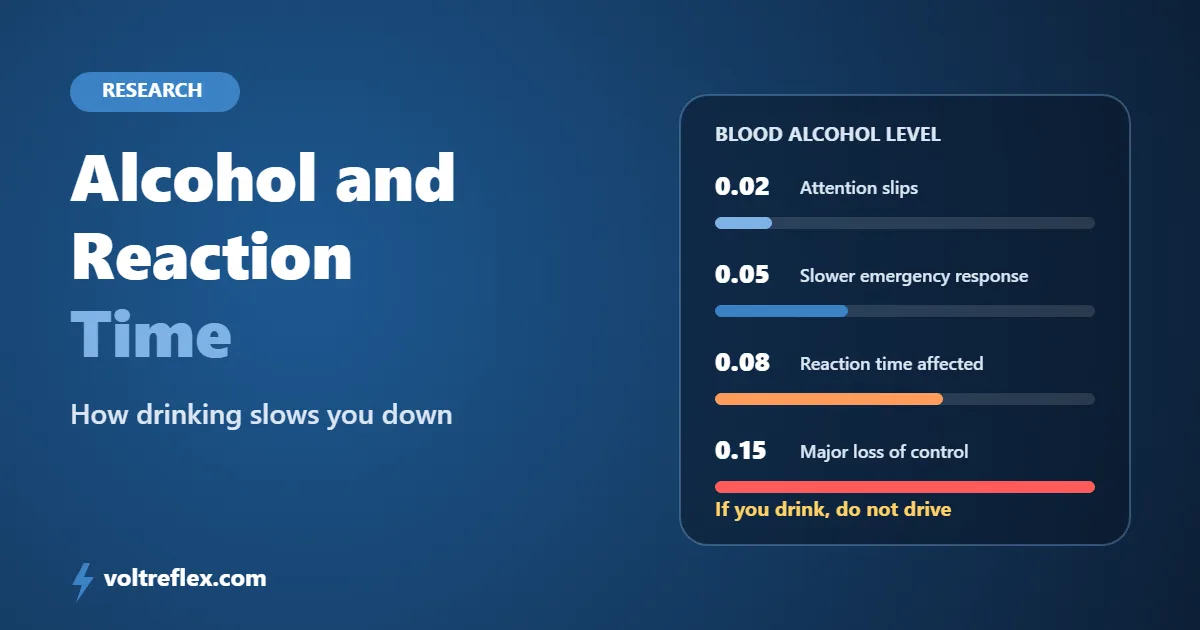
Alcohol and reaction time have a simple relationship. The more alcohol in your blood, the slower you notice, decide and act. And the effects start well before you feel drunk.
Want to know your normal sober baseline? Take the free VoltReflex reaction time test on a clear-headed day.
Key takeaways
- Effects on vision and divided attention start around 0.02 BAC.
- From 0.05 BAC, response to emergency driving situations drops.
- In one study, drivers at about 0.07 BAC drove worse but felt just as confident.
- In 2024, 11,904 people died in US alcohol-impaired driving crashes.
What Happens at Each Blood Alcohol Level
Blood alcohol concentration, or BAC, measures how much alcohol is in your blood. NHTSA describes what typically happens at each level.
| BAC | What changes | Effect on driving |
|---|---|---|
| 0.02 | Some loss of judgement, relaxed mood | Harder to track moving targets and do two things at once |
| 0.05 | Lower alertness, impaired judgement | Reduced coordination and slower response to emergencies |
| 0.08 | Poor coordination, reaction time affected | Weaker concentration, speed control and hazard spotting |
| 0.10 | Clear deterioration of reaction time | Trouble staying in lane and braking properly |
| 0.15 | Major loss of balance and control | Substantial impairment in vehicle control |
Notice that reaction time shows up by name at 0.08 and 0.10. But the slower processing behind it begins much earlier.
Why Alcohol Slows Your Reactions
Alcohol is a depressant. It slows down communication in the brain and nervous system.
Seeing
Your eyes track moving objects less well, so hazards are noticed later.
Deciding
Processing slows and attention narrows, so choosing what to do takes longer.
Acting
Coordination drops, so movements are slower and less precise.
Each step adds a little delay. Together they can turn a near miss into a crash. Our post on average reaction time while driving shows how far a car travels in that extra time.
The Dangerous Part, You Feel Fine
A 2022 placebo-controlled study tested 17 people in a driving simulator at different alcohol levels.
At an average BAC of about 0.07, their driving and choice reaction time were clearly worse. Their confidence in their own driving did not change at all.
That is the trap. The brain you would use to judge yourself is the brain alcohol is affecting.
"Alcohol does not just slow your reactions. It also hides the fact that they are slower."
Never use a reaction test to decide if you can drive A good score after drinking does not mean you are safe. If you have had alcohol, do not drive. Call a taxi, use public transport or hand the keys to a sober friend.
What It Costs on the Road
According to the CDC, using 2022 data, about 37 people in the United States are killed every day in crashes involving an alcohol-impaired driver. That is one death every 39 minutes.
NHTSA reports that 11,904 people died in alcohol-impaired driving crashes in 2024 alone.
The Next Day Matters Too
Only time lowers your blood alcohol level. Coffee, water and cold showers do not speed it up.
A late night of drinking also tends to mean poor sleep, and tiredness slows reactions on its own. Read more in how sleep deprivation affects reaction time.
Know your baseline Take the VoltReflex reaction time test when you are rested and sober, and note your average. Compare it with the benchmark data to see where your normal sits.
Frequently Asked Questions
How does alcohol affect reaction time?
How many drinks does it take to slow reaction time?
Can I feel if my reactions are slower after drinking?
Can I use a reaction test to see if I am okay to drive?
How long does alcohol affect reaction time?
Does coffee cancel out alcohol?
The Bottom Line
Alcohol and reaction time do not mix. Effects begin at low levels, grow with every drink, and come with a false sense of confidence.
If you drink, do not drive. And if you want to see your real reflexes, test your reaction time when you are sober and well rested.
VoltReflex results are for entertainment and self-benchmarking, not a medical diagnosis and never a test of fitness to drive.