You took the test, expected something fast, and got 320 ms. Or 380. Or a score much slower than last week. So why is your reaction time slow?
Quick answer. A slow reaction time is usually caused by tiredness, distraction or your device, not by bad reflexes. Poor sleep, a phone or 60 Hz screen, a busy mind and skipping a warm-up can each add tens of milliseconds. Fix those, and most people see a faster score straight away.
Below are the nine most common causes, how to spot each one, and what to do. Want a fresh baseline first? Take the free reflex test with 10 rounds.
Key takeaways
- Most slow scores are fixable. Sleep, focus and setup cause more slowness than genetics.
- Sleep loss is the big one. After 17 to 19 hours awake, test performance can match a 0.05% blood alcohol level.
- Your phone or screen adds delay on top of your real reaction.
- Mental fatigue and distraction cause slow "lapse" clicks that drag your average up.
- Judge your 10-round average, not one bad click.
First, Is Your Reaction Time Really Slow?
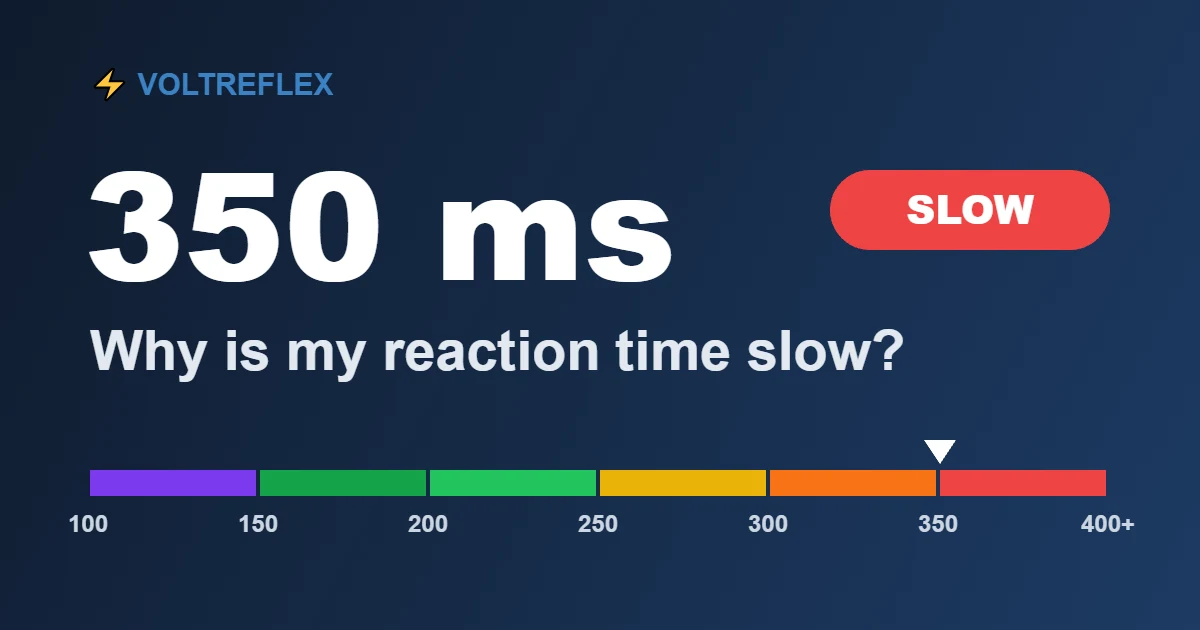
On an online click test, the typical adult scores around 250 to 300 ms. A score of 300 ms is only slightly below average. Scores above about 350 ms are the ones worth investigating.
See what each range means in our guide is 200ms reaction time good?, or compare by age and device on the benchmarks page.
Use this quick check to narrow down the cause.
| What you notice | Likely cause | First fix |
|---|---|---|
| Slow on phone, fine on PC | Device and touchscreen lag | Test on a computer with a wired mouse |
| Slow late at night or after a short night | Sleep loss | Retest after a full night of sleep |
| Mostly fast, with a few very slow clicks | Distraction or attention lapses | Silence your phone, close other tabs |
| Slower the longer you play | Mental fatigue | Take a 10-minute break |
| First 2–3 rounds slow, then faster | No warm-up | Do a few practice rounds first |
| Slow every time, on every device | Lifestyle or a health factor | Check sleep, activity, and talk to a doctor if it persists |
9 Common Causes of Slow Reaction Time
1. Lack of sleep
Sleep is the single biggest cause of slow reactions. In a well-known study, Williamson and Feyer (2000) found that after 17 to 19 hours awake, performance on some tests was as bad as, or worse than, at a 0.05% blood alcohol level, with response speeds up to 50% slower on some tests.
Fix. Aim for 7–9 hours, and don't judge your reflexes late at night after a long day. More in sleep and reaction time.
2. Your device and screen
Your score is your reaction plus your hardware. Phones and touchscreens add their own processing delay, which is why mobile scores are usually slower. A 60 Hz screen only redraws every 16.7 ms, and wireless or Bluetooth mice add more lag.
Fix. Test on a computer with a wired mouse and a high refresh rate screen if you can. See monitor refresh rate, mouse input lag and how accurate online reaction tests are.
3. Distraction and divided attention
A notification, a second screen or a wandering thought can turn one click into a 500 ms outlier. A few of those ruin your average. A recent study of medical students found that both visual and auditory reaction times got slower after an hour of smartphone use.
Fix. Phone on silent, other tabs closed, eyes on the box.
4. Mental fatigue
Long stretches of focused work or gaming tire your attention. Reaction times and missed signals both tend to increase the longer a task goes on; in one study cited in a 2022 review, reaction time rose by about 5% after three hours on a task. In a recent experiment, a mentally tiring app session made reaction time about 118 ms slower.
Fix. Test fresh, and take short breaks during long sessions.
5. Skipping the warm-up
Your first two or three rounds are usually your slowest while your attention settles into the task. Starting cold makes your average look worse than you really are.
Fix. Do a few practice rounds, or try our 5-minute reaction time warm-up.
6. Alcohol and drowsy medicines
Alcohol slows reaction time, which is exactly why researchers compare sleep loss to blood alcohol levels. Some medicines can also make you drowsy and slower to react.
Fix. Don't test, drive or compete after drinking. If a medicine label warns about drowsiness, take that seriously, and ask your pharmacist or doctor if you're unsure. See also reaction time while driving.
7. Dehydration and skipped meals
A 2018 meta-analysis found that once fluid loss passes about 2% of body weight, attention and coordination suffer, while the simplest reaction tasks are affected less. Being very hungry or thirsty mostly hurts your focus, and focus is what keeps your clicks consistent.
Fix. Drink regularly and eat a light meal a couple of hours before a long session.
8. Age
Reaction time is usually fastest in your twenties and slows gradually after that. This is normal and happens slowly, so a sudden big drop is not explained by age alone.
Fix. Compare yourself with people your own age using average reaction time by age.
9. Low physical activity
Exercise supports processing speed. In a 2015 study of 120 students, those who exercised regularly reacted faster than sedentary peers, and a meta-analysis of 79 studies found even a single workout gives a small short-term boost.
Fix. Regular cardio, and a short walk before an important session.
Test yourself Fixed one of these? Retake the VoltReflex reflex test with 10 rounds and compare your new average with the reaction time benchmarks.
Quick Fixes Before Your Next Test
- Test when rested, not late at night.
- Use a computer and a wired mouse if possible.
- Silence your phone and close other tabs.
- Do 2–3 warm-up rounds, then 10 rounds that count.
- Rest your finger on the button and watch for the colour change.
- Judge your average, not your best or worst click.
For longer-term gains, follow our guide on how to improve your reaction time.
When to Talk to a Doctor
A slow online test score on its own is rarely a medical problem. But talk to a doctor if your reactions stay much slower for weeks even after better sleep and rest, or if slowness comes with other changes such as ongoing tiredness, weakness, clumsiness, or trouble with vision, speech or memory. Get urgent help for sudden weakness, numbness, confusion or trouble speaking.
Frequently Asked Questions
Why is my reaction time slow on my phone?
Why is my reaction time slower than it used to be?
Why is my first try always slow?
Is 300ms reaction time slow?
Can slow reaction time be fixed?
The Bottom Line
If your reaction time is slow, start with the easy suspects. Sleep, your device, distraction and fatigue. These explain most slow scores, and fixing them often brings your average down the same day.
Then measure properly. Take the VoltReflex reflex test, do 10 rounds, and track your average over time.
VoltReflex results are for entertainment and self-benchmarking, not a medical diagnosis.
Sources
- Williamson and Feyer (2000), Moderate sleep deprivation produces impairments equivalent to alcohol intoxication, Occupational and Environmental Medicine.
- Smartphone use and reaction time in medical students, cross-sectional study, PMC.
- Frontiers in Psychology (2022), review of time-on-task and mental fatigue protocols.
- Mobile app-induced mental fatigue and neuromuscular performance, PMC.
- Wittbrodt and Millard-Stafford (2018), Dehydration impairs cognitive performance. A meta-analysis.
- Jain et al. (2015), Visual and auditory reaction times by gender and physical activity.
- Chang et al. (2012), The effects of acute exercise on cognitive performance. A meta-analysis, Brain Research.