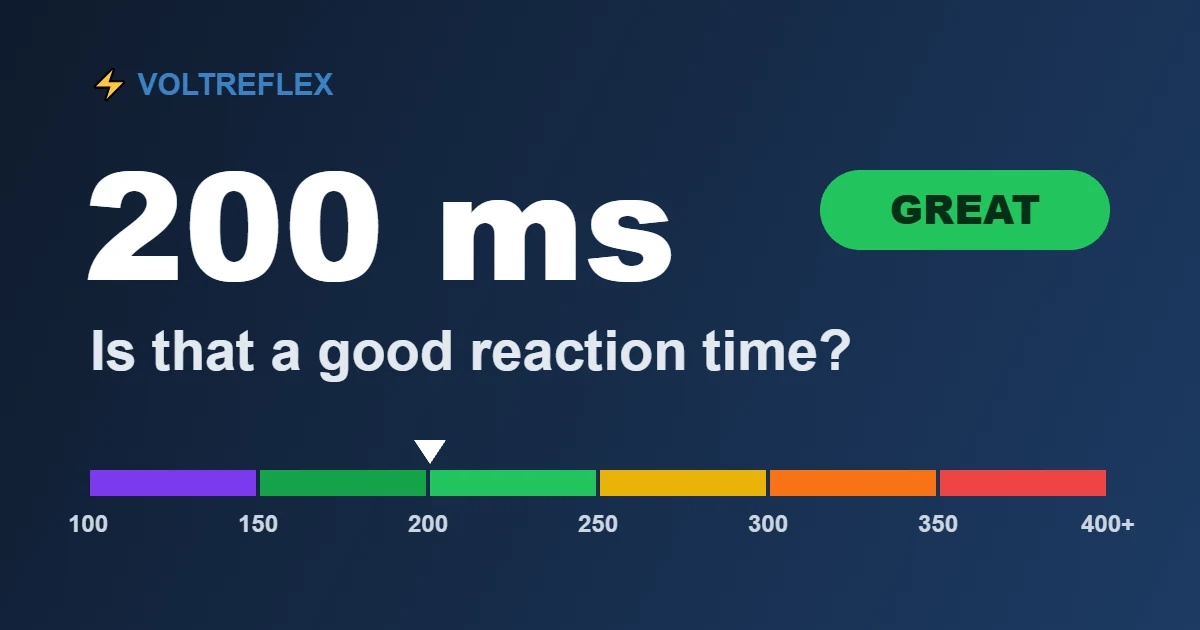
You just clicked the green box and saw 200 ms. Is that fast, normal or slow?
Short answer. Yes, 200ms reaction time is good. It is about 70 ms faster than the typical person on an online click test. On the VoltReflex scale it sits right on the line between “Great” and “Excellent”, the range where many trained gamers and athletes land.
But one number never tells the whole story. Below you will find what every score from 100 to 400 ms means, why your device matters, and how to get a reliable result. Not sure of your number yet? Take the free reflex test first, then come back.
Key takeaways
- 200 ms is a good reaction time. It beats the human median of about 273 ms on online click tests.
- Under 150 ms is elite. Very few people hit it consistently.
- Under 100 ms is almost always a guess, not a reaction. Sprint timing systems call it a false start.
- Your device adds its own delay, so a phone score will usually look slower than a PC score.
- Use your average of 10 rounds, not your single best click.
Is 200ms Reaction Time Good? The Short Answer
Yes. A 200ms reaction time is faster than most people.
Human Benchmark, one of the largest online reaction tests, reports a median of 273 ms across its users. A score of 200 ms puts you well ahead of that middle point.
That means your brain spotted the color change, decided to act, and sent the signal to your finger in one-fifth of a second. For a simple visual test with a normal mouse or touchscreen, that is a strong result.
Reaction Time Scale, What Every Score Means
Here is how VoltReflex rates scores on a simple visual click test. Find your average and see where you stand.
| Score (ms) | Rating | Approx. percentile | What it means |
|---|---|---|---|
| Under 100 | Check it | Not a real reaction | Almost certainly an early click or a lucky guess |
| 100 to 150 | Superhuman | Top 1% | Elite sprinter or esports level, and rare even there |
| 150 to 200 | Excellent | Top 10% | Typical of trained gamers and athletes |
| 200 to 250 | Great | Top 30% | Clearly above average |
| 250 to 300 | Average | Middle of the pack | Normal for a healthy adult |
| 300 to 350 | Below average | Bottom 35% | Often tiredness or distraction |
| Over 350 | Slow | Bottom 15% | Usually fatigue or a slow device, not slow reflexes |
For more context by age and device, see the full VoltReflex reaction time benchmarks.
Score by Score, 100ms, 130ms, 150ms, 200ms and More
People search for their exact number, so here is a quick verdict for the most common ones.
Is 100ms reaction time good?
A 100 ms score on a visual click test is almost certainly not a true reaction. In sprinting, World Athletics treats any start faster than 0.100 seconds as a false start, because officials assume nobody can genuinely react that fast. If you see 100 ms, you probably clicked a moment before the screen changed and got lucky.
Is 130ms reaction time good?
Yes, 130 ms is outstanding, but treat a single 130 ms click with caution. An analysis of sprint starts at the 2008 Beijing Olympics found that even elite male sprinters reached about 0.109 seconds in only one out of 1,000 starts, and they react to sound, which is faster than sight. A 130 ms average on a visual test would be exceptional.
Is 150ms reaction time good?
Yes, 150 ms is excellent. It sits at the edge of the top 1%. If you can average close to 150 ms over 10 rounds, your reflexes are in pro territory.
Is 180ms or 197ms reaction time good?
Yes. Anything between 150 and 200 ms is excellent and typical of people who game competitively or train in fast sports. A 197 ms score is just inside the Excellent band.
Is 200ms reaction time good?
Yes. 200 ms is good to excellent. It is roughly 70 ms faster than the online median and sits near the top 10 to 30 percent on our scale.
Is 250ms reaction time good?
250 ms is average to slightly above average. It is very close to the typical healthy adult on an online test. Nothing to worry about.
Is 300ms reaction time good?
300 ms is a little below average, but it is still normal. Tiredness, a slow screen or a phone can easily push a 250 ms person up to 300 ms.
Is 350ms or 400ms reaction time bad?
Not necessarily. Scores over 350 ms usually point to your setup or your state, not your nervous system. Try again when rested, on a computer with a wired mouse, and with notifications off. For the full checklist, see why is my reaction time slow?
Why the Same Person Gets Different Scores
Your score is your brain plus your hardware. That is why two tests can give you two different numbers.
- Your screen. A 60 Hz monitor only refreshes every 16.7 ms, so it can add up to about 16 ms of delay. Read more in does monitor refresh rate matter?
- Your mouse or touchscreen. Wireless and Bluetooth mice add delay, and touchscreens add more. See mouse input lag explained.
- Phone vs PC. Phones add their own processing delay, which is why mobile scores are usually slower.
- Sleep and focus. Being tired is one of the biggest score killers. See how sleep affects reaction time.
- Type of signal. People react faster to sound than to light. A 2015 study of 120 medical students found auditory reaction times were faster than visual ones, and students who exercised regularly were faster than sedentary ones.
Tip. Only compare scores taken on the same device, at a similar time of day.
Test yourself Want to know if you are a 200 ms player? Take the free VoltReflex reflex test. It takes under two minutes, needs no sign-up, and shows your average, best score and percentile. Then compare it with our reaction time benchmarks.
How to Get an Accurate Score
A single click is luck. A good measurement takes a few steps.
- Do at least 10 rounds. Your first two or three clicks are usually slower while your attention settles.
- Judge yourself by your average, not your best. Your best is often a lucky near-guess.
- Use a computer with a wired mouse if you can, and close other apps.
- Rest your finger on the button, ready but not pressing.
- Ignore scores under 100 ms. Treat them as early clicks.
Can You Get from 250ms to 200ms?
Often, yes. Many people shave 20 to 40 ms off their average with better sleep, a faster setup, regular practice and a short warm-up. You will not change your nervous system overnight, but you can remove the things slowing it down.
For a full plan, read how to improve your reaction time. Gamers should also try this 5-minute reaction time warm-up before ranked.
Frequently Asked Questions
Is 200ms reaction time good for gaming?
What is a good reaction time for my age?
What is the average reaction time in ms?
Why is my phone reaction time slower than on PC?
What is the fastest possible human reaction time?
The Bottom Line
If your average is around 200 ms, your reflexes are faster than most people’s. Below 150 ms is elite, 250 to 300 ms is normal, and anything above 350 ms is usually a sign to check your sleep or your device.
The best way to know where you really stand is to measure properly. Take the VoltReflex reflex test, do 10 rounds, and see your true average and percentile.
VoltReflex results are for entertainment and self-benchmarking, not a medical diagnosis.
Sources
- Human Benchmark, Reaction Time Test, median score across users.
- False start (Wikipedia), World Athletics 0.100 s rule and 2008 Beijing start analysis.
- Jain et al. (2015), A comparative study of visual and auditory reaction times, International Journal of Applied and Basic Medical Research.