Every sport has a moment where speed decides everything. The gun goes off, the ball leaves the bowler's hand, the punch starts to fly.
But reaction time by sport is not one number. A sprinter reacts to a single sound. A batter has to see, judge and swing at the same time.
First, find your own number. Take the free VoltReflex reaction time test, then compare it with the athletes below.
Key takeaways
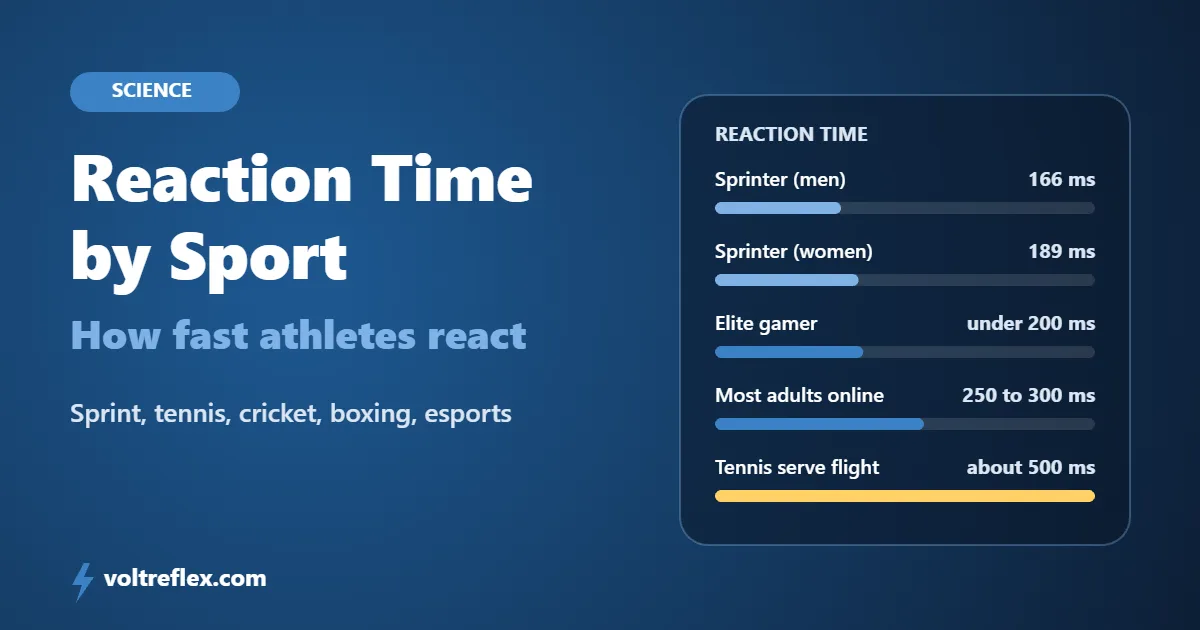
- Olympic sprinters average about 166 ms (men) and 189 ms (women) off the blocks.
- A fast serve, pitch or delivery gives players only around 0.4 to 0.5 seconds.
- Top athletes win by reading cues early, not just by reacting faster.
- Most adults score 250 to 300 ms on an online visual test.
Sprinting, the Purest Reaction Test
A sprint start is as close as sport gets to a lab test. One sound, one movement, measured by sensors in the blocks.
A study of 425 sprinters at the 2008 Beijing Olympics found the average fastest reaction was 166 ms for men and 189 ms for women.
The same researchers estimated the true human limit is about 109 ms for men and 121 ms for women. They also argued the female gap is partly caused by the starting blocks using the same force threshold for everyone.
"The rule says 100 ms. The fastest humans on Earth still need a little more than that to really react."
Ball Sports, Where Time Runs Out
In tennis, cricket and baseball, the ball sets the clock. Here is roughly how long players get, using simple speed and distance maths.
| Sport | Typical fast ball | Time to reach the player |
|---|---|---|
| Baseball | 90 mph pitch | About 0.4 to 0.45 s |
| Cricket | 145 km/h delivery | Under 0.5 s |
| Tennis | 200 km/h serve | Around 0.5 s |
These are rough figures that ignore air resistance and bounce. Even so, the point is clear.
Half a second sounds like a lot until you remember a simple reaction already takes around 200 ms. Add the time to judge the ball and swing, and there is almost nothing left.
The Secret Is Anticipation
So how do players hit a ball they barely have time to see? They start before it arrives.
Top returners read the server's toss and shoulders. Batters watch the bowler's wrist and run-up. They guess well, early.
A 2024 meta-analysis of 22 studies found that perceptual and decision training improved elite team athletes' anticipation and decision making. In other words, reading the game is a skill you can train.
Test yourself Run a 10 round reaction time test and see which athlete you are closest to. Then check the full tiers on our reaction time benchmarks.
Combat Sports
Boxers react to fists, feet and feints. Speed matters, but so does timing.
A 2025 study of boxers found their visual reaction time changed with the time of day. Morning types were sharper earlier, and evening types did better later.
That is useful for anyone. If you are a night owl, your best test scores may come in the evening.
Esports
Gamers react with their hands, not their whole body. That makes their simple reaction times look very fast.
Elite players often average under 200 ms. Research on action video games also suggests regular players get faster without losing accuracy. Read more in how pro players train their reflexes.
Not a fair fight A sprinter's time is measured by sensors in the blocks. Your online score includes screen and device delay. Use athlete numbers as inspiration, not as a direct comparison.
How Your Score Compares
| Your VoltReflex average | Rating | Who scores here |
|---|---|---|
| Under 150 ms | Superhuman | Rare, even among pros |
| 150 to 200 ms | Excellent | Trained athletes and gamers |
| 200 to 250 ms | Great | Regular gamers, alert young adults |
| 250 to 300 ms | Average | Most adults |
Want to move up a tier? Start with how to improve reaction time and a quick reaction time warm-up before you test.
Frequently Asked Questions
Which sport has the fastest reaction time?
What is a good reaction time for an athlete?
Why is a false start under 100 ms?
How do tennis players return serves so fast?
Can I train reaction time like an athlete?
Do esports players have faster reactions than athletes?
The Bottom Line
Reaction time by sport ranges from the pure 166 ms sprint start to the half second a tennis player gets to return a serve. The fastest athletes are not just quick. They read the game early.
You can train both sides. Practise, sleep well, and test your reaction time regularly to see how close you can get to the pros.
VoltReflex results are for entertainment and self-benchmarking, not a medical diagnosis.
Sources
- Lipps et al. (2011), Sex differences in the reaction times of sprinters at the Beijing Olympics
- Zhu et al. (2024), Perceptual-cognitive training on anticipation and decision making in team sports
- Kurak and Ilbak (2025), Time of day and visual reaction time in boxers
- Dye, Green and Bavelier (2009), Increasing Speed of Processing With Action Video Games