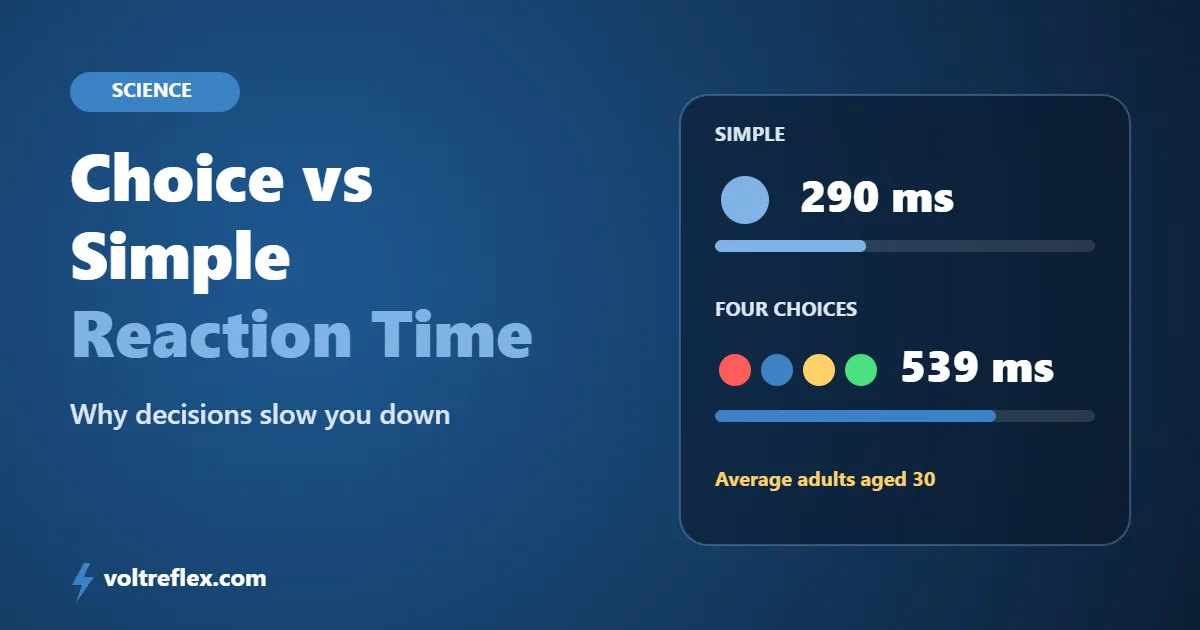
Press a button when a light turns on. Easy, and fast.
Now there are four lights and four buttons, and you have to press the right one. Suddenly you are much slower. That is the difference between choice vs simple reaction time.
Want your simple reaction number first? Take the free VoltReflex reaction time test. It measures exactly that.
Key takeaways
- Simple reaction time is one signal, one response.
- Choice reaction time adds a decision between several options.
- In a study of 2,196 adults, four-choice reactions took almost twice as long as simple ones.
- Choice reaction time also slows more with age.
What Is the Difference?
| Simple reaction time | Choice reaction time | |
|---|---|---|
| Signals | One | Two or more |
| Responses | One | One per signal |
| Decision needed | No | Yes |
| Example | Click when the screen turns green | Press left for red, right for blue |
| Real life | Sprint start | Returning a serve, choosing where to dodge |
Both start the same way. You notice the signal. The difference is what happens next.
With one possible response, your brain can prepare it in advance. With several, it has to work out which signal appeared and pick the matching action first.
The Numbers From Real Research
A study of 2,196 adults in Scotland measured both kinds of reaction time with the same device at three ages.
| Age | Simple reaction time | Four-choice reaction time | Extra time for the choice |
|---|---|---|---|
| 30 | 290 ms | 539 ms | 249 ms |
| 50 | 318 ms | 623 ms | 305 ms |
| 69 | 354 ms | 729 ms | 375 ms |
Adding a four-way choice almost doubled the time at every age. And the cost of the decision grew as people got older.
These simple times are higher than the 231 ms lab average from a separate study of 1,469 adults, because devices and methods differ. Compare the gap, not the exact numbers.
"Your hands are not the slow part. Choosing is."
Hick's Law, More Choices Means More Time
Psychologists noticed long ago that reaction time grows with the number of options. This pattern is known as Hick's law, and it is still discussed in research on interface design.
The key idea is that the time does not grow in a straight line. Each doubling of the options adds a similar amount of time.
- Going from 2 to 4 options costs about the same as going from 4 to 8.
- Familiar choices are faster, because practice shortens the decision.
- Unexpected options are slower, because your brain was not ready for them.
Test yourself VoltReflex measures simple reaction time. Run a 10 round reaction time test to see your base speed, then remember that real decisions add a lot on top.
Age Hits Choice Reactions Harder
A UK study of 7,130 adults found simple reaction time changed little until around age 50. Choice reaction time, on the other hand, slowed steadily across the whole adult age range.
That matches the Scottish numbers above. The decision part ages faster than the basic speed. Read more in average reaction time by age.
Why It Matters in Real Life
- Gaming. Picking a target or an ability is a choice reaction. Learning maps and enemy patterns cuts decision time. See how pro players train their reflexes.
- Sport. A sprinter makes a simple reaction. A tennis returner makes a choice reaction. That is why reading cues early matters so much in reaction time by sport.
- Driving. Brake or swerve is a choice, made under surprise. It is part of why driving reaction time is so much slower than a test score.
Do not compare different tests A simple reaction score and a choice reaction score measure different things. Compare your VoltReflex results with other simple reaction results only.
Frequently Asked Questions
What is the difference between simple and choice reaction time?
How much slower is choice reaction time?
What is Hick's law?
Does VoltReflex test simple or choice reaction time?
Does age affect choice reaction time more than simple reaction time?
Can you train choice reaction time?
The Bottom Line
Choice vs simple reaction time comes down to one thing, the decision. Adding a choice can nearly double your response time, and that cost grows with age.
Your basic speed is still the foundation. Test your simple reaction time and track it, then practise the decisions that matter in your game or sport.
VoltReflex results are for entertainment and self-benchmarking, not a medical diagnosis.