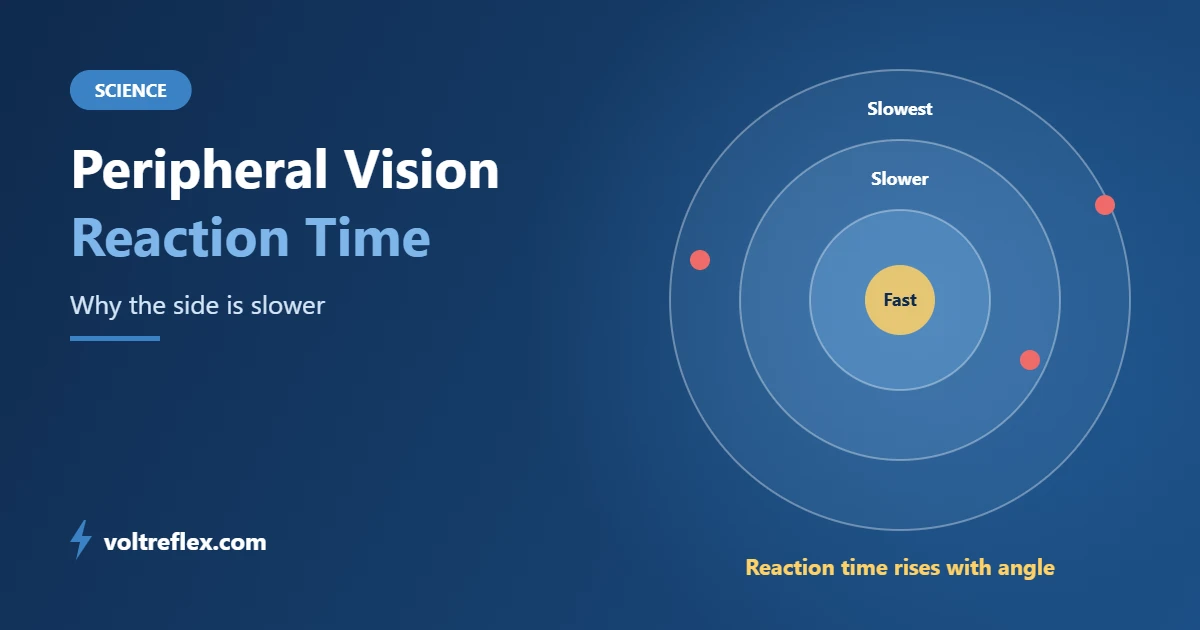
An enemy appears at the edge of your screen. A car pulls out from the side of the road. You react, but not as fast as when something happens right in front of you.
That delay is normal. Research shows peripheral vision reaction time gets slower the further a target is from the centre of your view.
Start with your central baseline. Take the free VoltReflex reaction time test, which measures how fast you react to a change in the middle of the screen.
Key takeaways
- Reaction time increases with eccentricity, meaning the further to the side, the slower.
- The centre of your eye sees fine detail, the edges see much less.
- Skilled athletes can partly compensate in game-like situations.
- The VoltReflex test measures central vision, so side reactions in real life will be slower.
The Short Answer
You react fastest to things right in front of you. As a target moves out towards the edge of your view, your reaction time gets longer.
Researchers call this the eccentricity effect. It shows up in lab tests, virtual reality and sport specific tasks.
What the Research Shows
A 2026 study in Frontiers in Virtual Reality tested 27 healthy adults on a virtual reaction wall, with targets placed at different angles. The authors report that reaction times increased with eccentricity, matching what earlier real world studies found.
The same paper describes how vision is often split by angle from the centre.
| Zone | Angle from centre | Reaction speed |
|---|---|---|
| Central | Straight ahead | Fastest |
| Near periphery | About 8 to 30 degrees | Slower |
| Mid periphery | About 30 to 60 degrees | Slower still |
| Far periphery | Beyond 60 degrees | Slowest |
A 2024 study in Scientific Reports used first person basketball scenes with targets up to 90 degrees to the left and right. It found eccentricity effects in every condition, from simple reactions to a game simulation.
Exact millisecond costs depend on the setup, so we have not listed a single number here. The direction of the effect is very consistent.
These bars show the pattern, not measured times.
Why the Side Is Slower
The centre of your retina is packed with cells built for sharp detail. Towards the edges, detail drops away, so a target there is harder to pick out.
Attention matters too. A classic 1985 study found that reaction time generally increased with distance from where people were paying attention. Most of the time your attention sits where you are looking.
"Your eyes see a wide world, but your brain gives the centre the fast lane."
How Experts Compensate
The 2024 basketball study found something interesting. In the choice task and the game simulation, highly skilled players compensated for side targets, while less skilled players did not.
The likely reason is experience. Experts know where threats usually come from and what a real cue looks like, so they need less time to decide. That fits with how choice reaction time depends on how many options you are weighing.
Peripheral Vision in Gaming and Sport
- Gaming. Minimaps, kill feeds and enemies near the screen edge all sit outside central vision.
- Team sports. Players track teammates and opponents to the side while watching the ball.
- Driving. Cars and people entering from the side take longer to notice. See reaction time while driving.
For shooters, keeping your crosshair where enemies usually appear turns many side reactions into central ones. Our guide on good reaction time for Valorant and CS2 explains why.
Test yourself Do 20 rounds of the reaction time test to get your central baseline. Any real situation with side targets will be slower, so use this score as your best case.
How to Improve Your Side Reactions
- Learn the hot spots. Knowing where cues usually appear cuts decision time.
- Check your screen distance. Sit so important parts of the screen are not too far into your side vision.
- Practise game situations. The study suggests skill helps most in realistic tasks, not simple ones.
- Stay fresh. Tiredness narrows attention. See sleep and reaction time.
Most adults score around 250 to 300 ms on an online test with a central target. Check the full ranges on our benchmarks page.
Frequently Asked Questions
Is reaction time slower in peripheral vision?
Why is peripheral vision slower?
Can you train peripheral vision reaction time?
Does peripheral vision matter in gaming?
Does VoltReflex test peripheral vision?
The Bottom Line
Peripheral vision reaction time is slower than central reaction time, and it gets slower the further to the side a target appears. Skilled players can reduce the cost by knowing what to expect.
Take the VoltReflex test to measure your central speed, then work on reading the edges of the screen or field.
VoltReflex results are for entertainment and self-benchmarking, not a medical diagnosis.
Sources
- Bürger et al. (2026), Effects of central and peripheral Go and No-Go signals on reactions to peripheral stimuli in virtual reality, Frontiers in Virtual Reality
- Vater (2024), Viewing angle, skill level and task representativeness affect response times in basketball defence, Scientific Reports
- Shulman, Wilson and Sheehy (1985), Spatial determinants of the distribution of attention, Perception and Psychophysics