You peek, they shoot first, and the kill cam makes it look like you never had a chance. It is easy to blame your reactions.
Sometimes that is fair. More often the fight was decided by crosshair placement, ping or who had the angle. Knowing your real reaction time helps you tell the difference.
Start with a baseline. Take the free VoltReflex reaction time test with your gaming mouse and monitor, then compare your average below.
Key takeaways
- On an online test, 200 to 250 ms is great and 150 to 200 ms is excellent.
- There is no official reaction time data by rank for Valorant or CS2.
- Your monitor, mouse, ping and server tick rate all add delay on top of your reaction.
- Crosshair placement and game sense usually matter more than shaving 10 ms.
The Short Answer
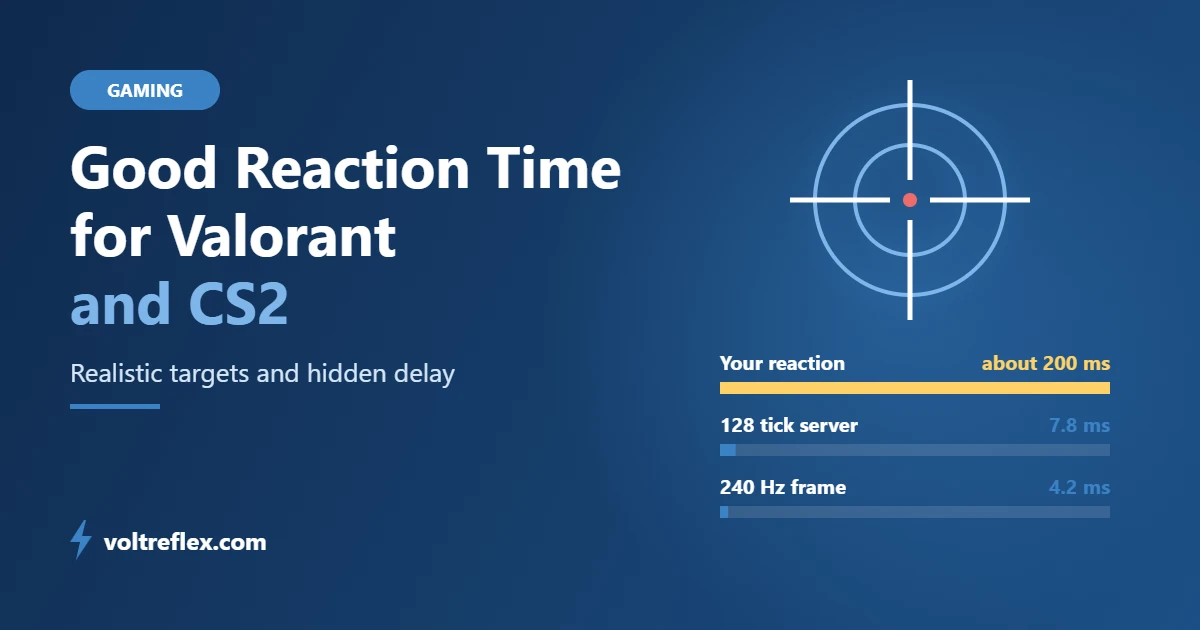
A good reaction time for Valorant and CS2 is around 200 ms or faster on an online test like VoltReflex. That is quicker than most adults and plenty for high level ranked play.
Be careful with charts online that list an exact reaction time for each rank. We could not find any official data from Riot or Valve that supports them, so treat those numbers as guesses.
Realistic Score Targets
These ranges use the same online test scale as our reaction time benchmarks. Online scores include some device delay, so they run a little slower than lab results.
| Your average | Rating | What it means in game |
|---|---|---|
| Under 150 ms | Superhuman | Rare, even among pro gamers |
| 150 to 200 ms | Excellent | Typical of trained gamers |
| 200 to 250 ms | Great | Fast enough for high ranked play |
| 250 to 300 ms | Average | Most adults, room to gain with setup and rest |
| Over 300 ms | Below average | Often tiredness, distraction or device delay |
If you sit near 200 ms, you are in good company. Our guide on whether 200 ms is a good reaction time explains the ranges in more detail.
Where the Hidden Delay Comes From
In a real gunfight your reaction is only one link in the chain. Every link adds milliseconds before your shot counts.
- Monitor. A 60 Hz screen shows a new frame every 16.7 ms. At 240 Hz it is about 4.2 ms. See monitor refresh rate and reaction time.
- Mouse. At 125 Hz polling a click waits about 4 ms on average, at 1000 Hz about 0.5 ms. Read mouse input lag explained.
- Server tick. Riot says a 128 tick Valorant server must process each frame within about 7.8 ms.
- Ping. Network delay adds to everything above and changes from match to match.
Riot also notes that every online shooter has some peeker's advantage. The player moving around a corner can see you a moment before you see them, partly because of network delay and tick rate.
"Your reaction is the biggest number in the chain. Your setup decides how much extra you carry on top."
Valorant vs CS2
Both games reward the same core skills, and the same reaction time targets apply to both. The main differences are in how the servers handle your inputs.
| Valorant | CS2 | |
|---|---|---|
| Server updates | 128 tick servers | Sub-tick system |
| Time to kill | Fast, headshots are key | Fast, headshots are key |
| Abilities | Flashes and utility shape fights | Grenades and utility shape fights |
| Good online score | Around 200 ms or faster | Around 200 ms or faster |
CS2 uses what Valve calls sub-tick updates, which aim to record when you actually clicked between server ticks. Either way, the best fix you control is your own setup and your ping.
What Matters More Than Speed
A simple reaction test measures one thing. You see a change and click. In a match you also have to find the enemy, decide whether to shoot and move your crosshair onto them.
That makes in game reactions slower than test scores, because more choices mean more thinking time. Our post on choice vs simple reaction time explains why.
A 2022 study in Frontiers in Human Neuroscience tested 32 professional and semi professional shooter players on flicking tasks. Players reacted faster when targets were large and speed was rewarded, and players with better motor control also tended to react faster. In short, aim mechanics and reaction speed work together.
- Crosshair placement. Keep it at head height where enemies appear so you barely need to move.
- Pre-aiming angles. Expecting where an enemy will be turns a choice reaction into a simple one.
- Game sense. Sound, timing and info from teammates let you react before you even see someone.
Test yourself Do 20 rounds of the reaction time test before a ranked session and 20 after. If your average drops a lot by the end, fatigue is costing you fights.
How to React Faster in Game
- Warm up before ranked. A short routine sharpens focus. Try our reaction time warm-up.
- Fix your setup once. Use 1000 Hz polling, the highest refresh rate your monitor supports and a wired or 2.4 GHz connection.
- Lower your ping. Play on the closest servers and use a wired internet connection when you can.
- Play rested. Sleep loss slows reaction time more than most gear upgrades help. See sleep and reaction time.
- Train like a pro. Our guide on how pro players train their reaction time covers routines and drills.
Frequently Asked Questions
Is 200 ms a good reaction time for Valorant?
What reaction time do pro Valorant and CS2 players have?
Does ping matter more than reaction time?
Does 128 tick improve reaction time?
How can I react faster in Valorant and CS2?
The Bottom Line
A reaction time around 200 ms or faster on an online test is good for Valorant and CS2. Past that point, setup, ping and crosshair placement usually decide more fights than raw speed.
Take the VoltReflex test on your gaming setup, note your average and track it before and after your sessions.
VoltReflex results are for entertainment and self-benchmarking, not a medical diagnosis.