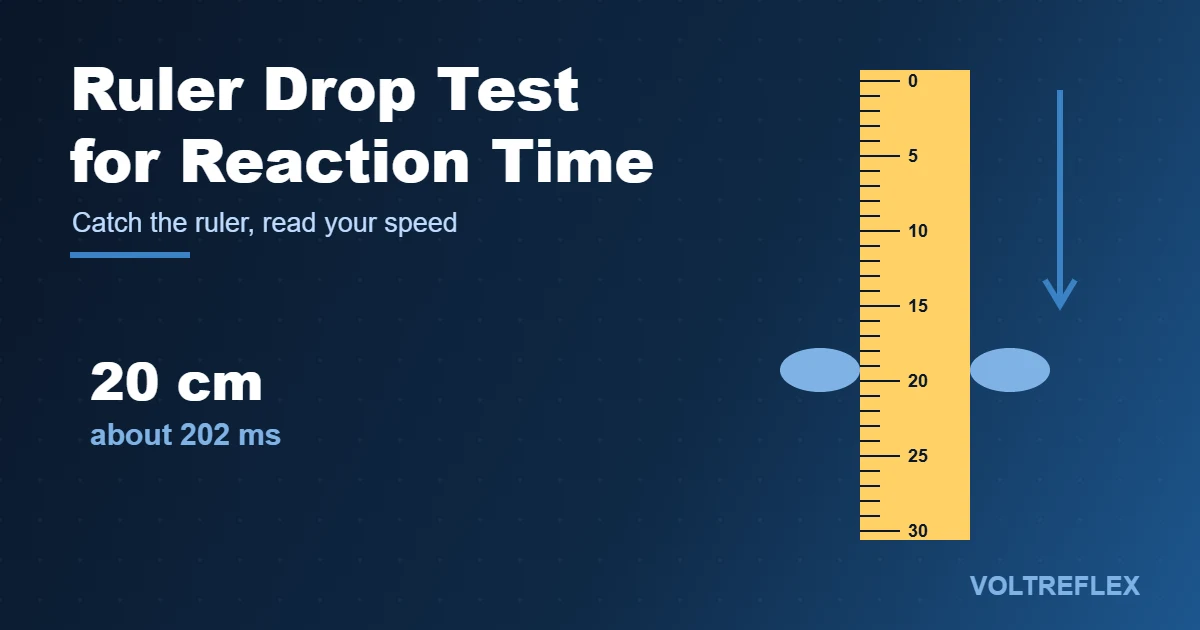
No app, no stopwatch, just a ruler and a friend. The ruler drop test is the oldest way to measure reaction time at home.
It is used in school science classes because it works. Here is how to do it, how to convert your result into milliseconds, and what your score means.
Want a second opinion? Try the free VoltReflex reaction time test after your ruler catches and compare.
Quick answer
- Catch at 10 cm means about 143 ms.
- Catch at 20 cm means about 202 ms.
- Catch at 30 cm means about 247 ms.
- Shorter distance, faster reaction.
How to Do the Ruler Drop Test
You need a 30 cm ruler and a partner. That is it.
- Sit with your forearm on a table and your hand just past the edge.
- Open your thumb and index finger a few centimetres apart at the zero mark.
- Your partner holds the top of the ruler and lets go without warning.
- Catch it as fast as you can and read the number above your thumb.
- Repeat 5 to 10 times and work out the average.
The IIHS classroom activity uses the same setup, with 10 catches per person and fingers held 4 cm apart.
Make it fair Watch the ruler, not your partner's hand. The dropper should change the waiting time on every try, so you cannot guess the moment.
Turning Centimetres Into Milliseconds
The ruler starts still and speeds up as gravity pulls it down. So the distance it falls tells you exactly how long you took.
The physics is simple. Distance equals half of gravity times time squared. Flip it around and you get the formula below.
Reaction time = √(2 × distance ÷ 9.81)
Use the distance in metres and you get the answer in seconds. The IIHS worksheet gives a handy shortcut, time equals 0.0452 times the square root of the distance in centimetres.
The NRICH maths project at the University of Cambridge walks through the same falling ruler idea, step by step.
Ruler Drop Conversion Chart
No calculator? Use this table. Values are rounded to the nearest millisecond.
| Distance caught | Reaction time | Rating |
|---|---|---|
| 5 cm | 101 ms | Very fast |
| 10 cm | 143 ms | Very fast |
| 15 cm | 175 ms | Fast |
| 20 cm | 202 ms | Fast |
| 25 cm | 226 ms | Average |
| 30 cm | 247 ms | Slower |
Notice something odd. Catching at 10 cm is not twice as fast as 20 cm. Because the ruler speeds up as it falls, the extra centimetres pass faster near the bottom.
What Is a Good Score?
Most people catch the ruler somewhere between 15 and 25 cm. That works out to roughly 175 to 226 ms.
Under 15 cm is quick. Missing the ruler completely means you took longer than about 247 ms on that try, so do not panic about one miss.
Want to see where you stand against a big group? Check our reaction time benchmarks.
Ruler Test vs Online Test
Your ruler score and your online score will rarely match. That is normal.
An online test adds the time your screen takes to show the change and the time your mouse or touchscreen takes to register the click. Read more in mouse input lag explained.
The ruler has its own weak spots. A human dropper is not perfectly random, and a sneaky glance at their fingers can give you a head start.
So use each one for what it does best. The ruler is a fun check with friends. A timed test like VoltReflex is better for tracking progress over weeks.
Do not compare across methods A 180 ms ruler score and a 230 ms online score can both be good. Compare ruler with ruler and online with online.
How to Catch It Faster
- Sleep well the night before. Tiredness slows every reaction, as our sleep and reaction time guide shows.
- Stay relaxed. Tense fingers close more slowly.
- Warm up with a few practice catches first.
- Focus on the ruler edge, not on the hand holding it.
For more ideas, read how to improve your reaction time.
Frequently Asked Questions
How do you do the ruler drop test?
How do you convert ruler distance to reaction time?
What is a good ruler drop score?
Why is my online test score slower than my ruler score?
How many times should I try the ruler drop test?
Is the ruler drop test accurate?
The Bottom Line
The ruler drop test is a simple, free way to measure reaction time. Catch at 20 cm and you reacted in about 200 ms.
Use the chart above, take an average of several catches, then test your reaction time online to track your progress.
VoltReflex results are for entertainment and self-benchmarking, not a medical diagnosis.