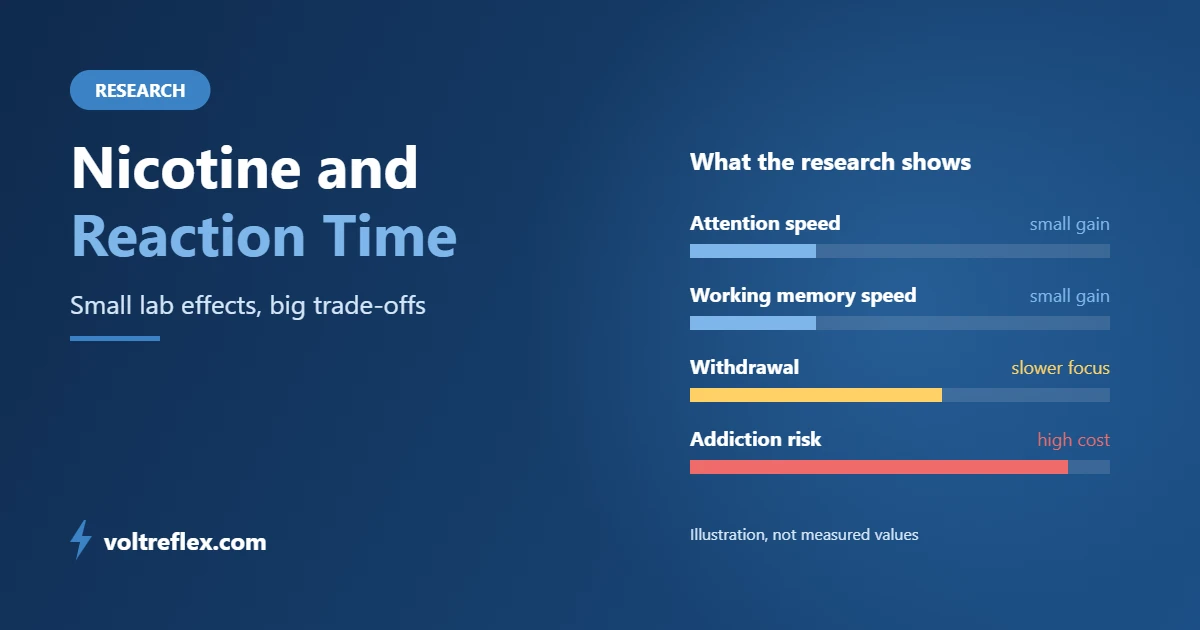
Some gamers and athletes wonder if nicotine sharpens their reactions. It is a fair question, because lab studies do show small effects on attention and speed.
But the full picture matters. The effects are modest, withdrawal makes them easy to misread, and nicotine is addictive. This post explains the research without promoting it.
Want a clean baseline? Take the free VoltReflex reaction time test and track what really changes your score.
Key takeaways
- A meta-analysis of 41 placebo-controlled studies found small to moderate gains in some attention and speed tasks.
- For regular users, part of the felt boost is simply relief from withdrawal.
- The US Surgeon General warns nicotine is addictive and can harm the developing brain.
- Sleep, warm-ups and practice are safer ways to react faster.
The Short Answer
Nicotine can slightly speed up some kinds of reaction in lab tests. The effects are small, and they are not a reason to start using it.
If you already use nicotine, you may feel sharper after a dose. Often that is your brain getting back to normal after time without it, not a real upgrade.
What the Research Shows
The best summary is a 2010 meta-analysis by Stephen Heishman and colleagues in the journal Psychopharmacology. It pooled 41 double-blind, placebo-controlled studies published from 1994 to 2008.
All the people tested were healthy adults who were either non-smokers or smokers who had gone no more than about two hours without nicotine. That design helps separate a real effect from withdrawal relief.
| Performance area | Effect of nicotine |
|---|---|
| Fine motor skills | Small improvement |
| Alerting attention, accuracy and response time | Small improvement |
| Orienting attention, response time | Small improvement |
| Short term memory accuracy | Small improvement |
| Working memory, response time | Small improvement |
The effect sizes ranged from 0.16 to 0.44. In plain words, that is small to moderate. Other areas in the review did not show a significant effect.
The authors also noted that these benefits may help explain why people start using nicotine and why it is hard to stop.
The Withdrawal Trap
For regular users, nicotine creates its own problem. Going without it for a while can make concentration worse, and the next dose brings you back.
A 2011 study tested 365 smokers twice, once after 10 hours without nicotine and once when not deprived. It found modest changes in attention control, and those changes were linked to how well people managed to quit later.
"Feeling sharper after nicotine often just means you are back to where a non-user starts."
This is why a smoker's reaction time can look better after a cigarette. The comparison is with their own withdrawal, not with a rested non-user.
Test yourself If you are cutting down, do 20 rounds of the reaction time test each day at the same time. Many people see their scores settle as the first weeks pass.
Why It Is Not a Performance Aid
The US Surgeon General's report on e-cigarettes warns that nicotine is addictive and can harm brain development in teens and young adults.
A small gain on a lab task does not outweigh that. Most competitive players and coaches focus on things that help without the risks.
Health note Nicotine products are not safe for young people and are addictive for everyone. If you want help quitting, speak to a doctor or a local quit service.
Better Ways to React Faster
- Sleep. Tiredness slows you down far more than any small lab effect. See sleep and reaction time.
- Moderate caffeine. For adults it is a common short term focus aid with research behind it. Read caffeine and reaction time.
- Warm up. A short routine sharpens focus before you play. Try our reaction time warm-up.
- Practise. Our guide on how to improve your reaction time covers drills that work.
- Avoid alcohol before play. It slows reactions clearly. See alcohol and reaction time.
Most adults score around 250 to 300 ms on an online test. Check where you sit on our benchmarks page.
Frequently Asked Questions
Does nicotine improve reaction time?
Do smokers have faster reactions?
Does vaping affect reaction time?
Does nicotine withdrawal slow you down?
What is a safer way to react faster?
The Bottom Line
Nicotine can give small boosts on some attention and speed tasks in the lab, but the effects are modest and come with addiction. For regular users, much of the felt boost is relief from withdrawal.
If you want faster reactions, focus on sleep, practice and your setup. Take the VoltReflex test to see what really works for you.
VoltReflex results are for entertainment and self-benchmarking, not a medical diagnosis.
Sources
- Heishman, Kleykamp and Singleton (2010), Meta-analysis of the acute effects of nicotine and smoking on human performance, via PubMed
- Schlam et al. (2011), Cognitive conflict following appetitive versus negative cues and smoking cessation failure, via PubMed
- US Surgeon General (2016), E-Cigarette Use Among Youth and Young Adults, via CDC