Your hands feel shaky before a big match. Your heart is racing during an exam. Does that make you faster, or slower?
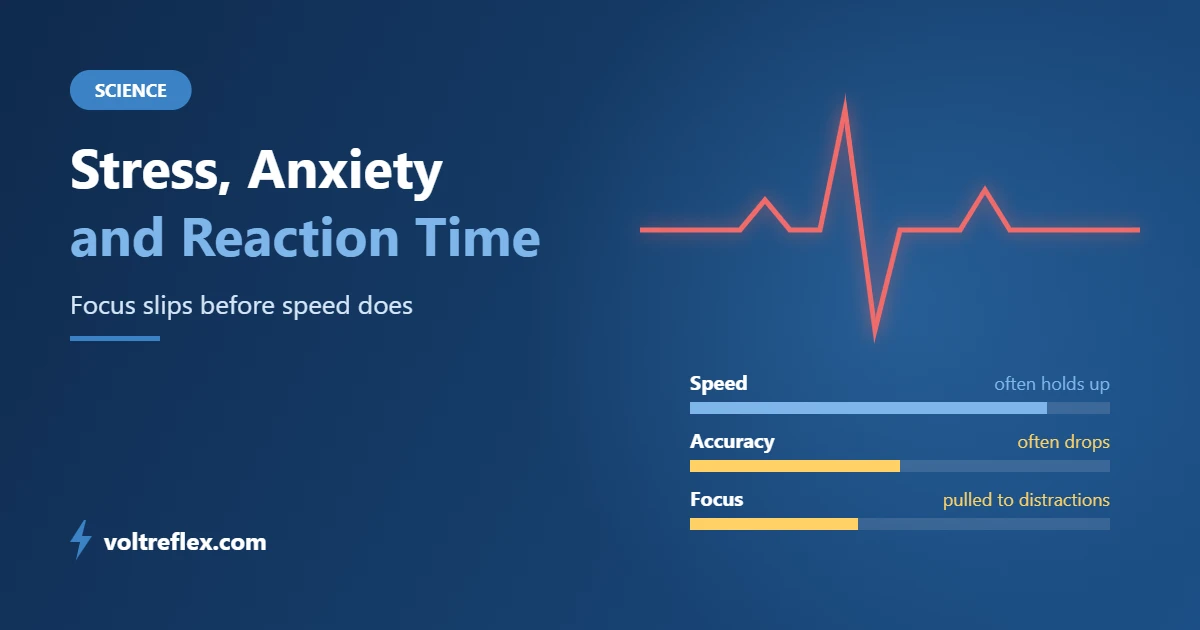
The honest answer is that it depends. Research suggests stress and anxiety often hit your focus and accuracy before they hit your raw reaction speed.
Want a calm baseline first? Take the free VoltReflex reaction time test when you feel relaxed, so you have something to compare against.
Key takeaways
- Simple reaction speed often holds up under short term stress.
- Accuracy and focus are more likely to suffer.
- Anxiety makes attention less efficient, so you work harder to keep the same score.
- Slow breathing, a warm-up and good sleep help you stay steady.
The Short Answer
Stress and anxiety do not simply make you slower. A little pressure can keep you alert, while heavy stress or anxiety tends to cause more mistakes, more distraction and less consistent times.
On a simple test like VoltReflex, you may see your times jump around more when you are nervous, even if your best clicks stay quick.
What Stress Does to Your Body
When you feel under threat, your body switches into a more alert state. Heart rate rises, breathing speeds up and stress hormones are released.
That can feel like being switched on. But the same state can also make you jumpy, tense and easily distracted, which is not ideal when you need clean, controlled reactions.
What the Research Shows
Attentional control theory, set out by Michael Eysenck and colleagues in 2007, is one of the best known explanations. It suggests anxiety weakens goal directed attention and makes you more easily pulled towards distractions and threats.
Importantly, the theory also says anxious people can often keep their performance up by trying harder. The cost shows up as extra effort and lower efficiency rather than always a worse result.
A 2023 study in Scientific Reports tested 50 young and 50 older adults after a standard stress test that involved public speaking and mental arithmetic.
| Group | Effect of stress on speed | Effect on accuracy |
|---|---|---|
| Young adults, 18 to 30 | No clear change | Lower accuracy |
| Older adults, 65 to 84 | Faster on a new task, slower on a practised one | Lower accuracy |
The pattern fits the theory. Speed can hold up, but mistakes creep in. The task in that study needed people to ignore distracting letters, which is closer to a game than a simple click test.
Good Pressure vs Too Much
A classic idea in psychology, often called the Yerkes Dodson law, says performance is best at a medium level of arousal. Too little and you are flat, too much and you fall apart.
Research support for that neat curve is mixed, so treat it as a rough guide rather than a rule. Still, many players and athletes recognise the feeling of being nicely switched on versus overwhelmed.
These bars are an illustration of the idea, not measured data.
"Stress rarely steals your speed first. It steals your focus, and the mistakes follow."
How Nerves Show Up in Your Score
- Early clicks. You start guessing the signal instead of waiting for it.
- Hesitation. Tension makes some reactions slower than usual.
- Bigger spread. Your fastest and slowest times move further apart.
- Lost focus. Your mind drifts to the result instead of the screen.
That is why the average and consistency of your times matter more than one fast click. If your scores are slow in general, our guide on why your reaction time might be slow covers the other common causes.
Test yourself Do 20 rounds of the reaction time test when you are calm, then 20 right after something stressful. Compare the average and how much your times vary, not just your best.
How to Stay Sharp Under Pressure
- Slow your breathing. A few slow breaths before you start can help you feel more in control.
- Use a routine. The same short warm-up every time makes pressure feel familiar. Try our reaction time warm-up.
- Sleep well. Tiredness and stress make each other worse. See sleep and reaction time.
- Watch the caffeine. A moderate amount can help focus, but too much can make you jittery. Read caffeine and reaction time.
- Focus on the process. Think about the next signal, not the final score.
Most adults score around 250 to 300 ms on an online test. Check the full ranges on our benchmarks page.
Health note Feeling anxious sometimes is normal. If anxiety does not go away or gets in the way of daily life, speak to a doctor or mental health professional. The US National Institute of Mental Health has clear information on anxiety disorders.
Frequently Asked Questions
Does anxiety slow your reaction time?
Does stress make you react faster?
Why are my scores worse when I am nervous?
Can anxiety affect gaming performance?
When should I worry about slow reactions and anxiety?
The Bottom Line
Stress and anxiety tend to hurt focus, accuracy and consistency before they hurt raw reaction speed. A little pressure can even help you stay alert.
Take the VoltReflex test in a calm moment and under pressure, then use the gap to learn how nerves affect you.
VoltReflex results are for entertainment and self-benchmarking, not a medical diagnosis.