People use the words reflex and reaction time as if they mean the same thing. They do not.
A reflex happens without you choosing it. Reaction time is how fast you respond when you do choose. The gap between them is surprisingly big.
Here is the simple version, with real numbers. Then test your reaction time to see where you land.
Key takeaways
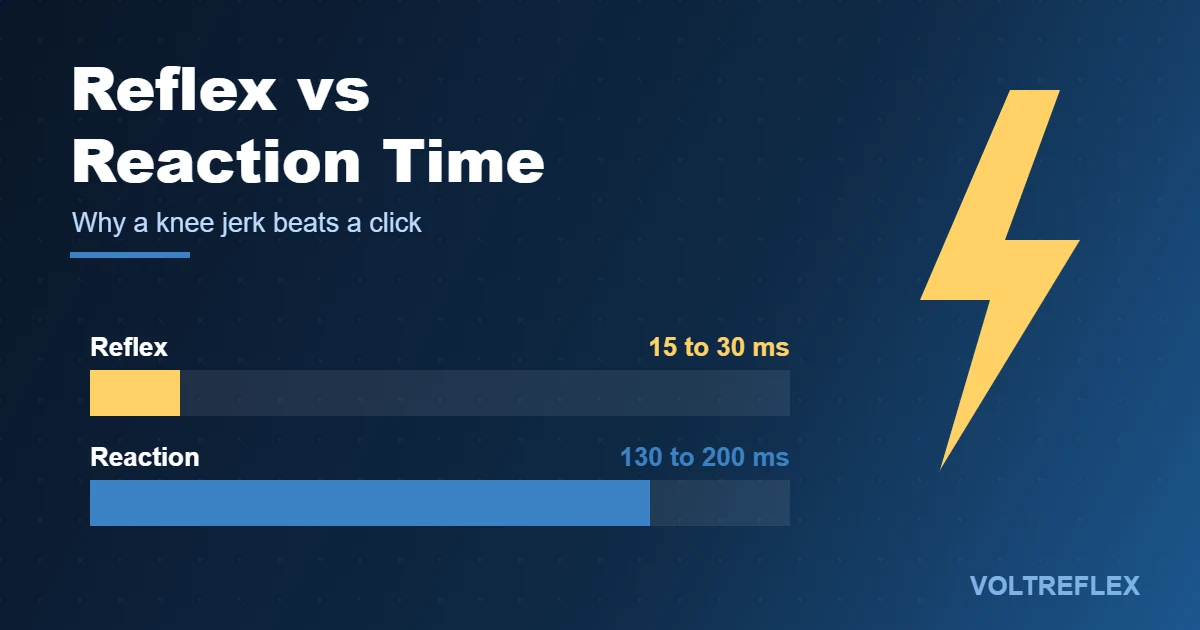
- A knee jerk reflex takes about 15 to 30 ms.
- A chosen response to the same tap takes about 130 to 200 ms.
- Reflexes skip the brain's decision step. Reactions do not.
- Online "reflex tests" actually measure reaction time.
Two Simple Definitions
The US National Library of Medicine defines reaction time as the time from the start of a signal until a response is seen.
A stretch reflex is described as an automatic muscle contraction when the muscle is stretched. No thinking is involved.
So a reflex is built into your wiring. Reaction time depends on your attention, your brain and the task in front of you.
| Reflex | Reaction | |
|---|---|---|
| Do you choose it? | No | Yes |
| Main path | Spinal cord loop | Up to the brain and back |
| Typical speed | 15 to 30 ms | 130 ms and up |
| Example | Knee jerk, pulling away from heat | Clicking when a screen turns green |
| Trainable? | Barely | Yes, with practice |
The Knee Tap Experiment
Neuroscience educators at Backyard Brains measured both in the same people. They tapped the knee and recorded the muscle.
The reflex fired in about 15 to 30 milliseconds. When people were asked to kick on purpose as soon as they felt the tap, it took about 130 to 200 milliseconds.
Same person, same leg, same tap. The only difference was whether the brain had to decide.
"A reflex skips the meeting. A reaction has to wait for the brain to sign off."
Why Reflexes Are So Much Faster
In a stretch reflex, a sensor in the muscle sends a signal to the spinal cord. The spinal cord sends a signal straight back to the same muscle.
That loop is short, and it has very few connections. Nothing has to be noticed, compared or chosen.
A reaction is a longer trip. Your eyes or ears pick up the signal, your brain works out what it means, picks a response and sends the command down to your hand.
Add a choice, like left or right, and it gets slower again. Our guide to choice vs simple reaction time explains why.
So What Does a "Reflex Test" Measure?
Online tests are often called reflex tests, including ours. But what they actually measure is simple visual reaction time.
You wait, you see the screen change, you decide it is time and you click. That is a full brain loop, not a spinal shortcut.
It also includes a little delay from your screen and mouse. See mouse input lag explained for how much.
Good to know If your score is around 200 to 250 ms, you are in a normal range for a voluntary reaction. Compare yourself on our benchmarks page.
Which One Can You Improve?
Spinal reflexes are mostly set by your nervous system. Doctors test them to check that the wiring works, not to rank anyone.
Reaction time is different. It responds to sleep, focus, warm-up and practice. Gamers and athletes also get faster by learning to read cues earlier.
- Sleep is the biggest free upgrade.
- Practice the exact task you care about.
- Warm up before games or matches.
Start with our guide on how to improve your reaction time.
Medical note Unusually weak, strong or missing reflexes are something a doctor should check. A slow online score on its own is not a sign of a problem.
Frequently Asked Questions
What is the difference between a reflex and reaction time?
How fast is a reflex?
Does a reaction time test measure reflexes?
Can you train your reflexes?
Why are reflexes faster than reactions?
Is catching a falling object a reflex?
The Bottom Line
A reflex is automatic and runs through the spinal cord in a few tens of milliseconds. Reaction time is a chosen response that goes through the brain and usually takes 150 ms or more.
When you take a "reflex test" online, you are really measuring reaction time. Try the VoltReflex test and see how your brain stacks up.
VoltReflex results are for entertainment and self-benchmarking, not a medical diagnosis.