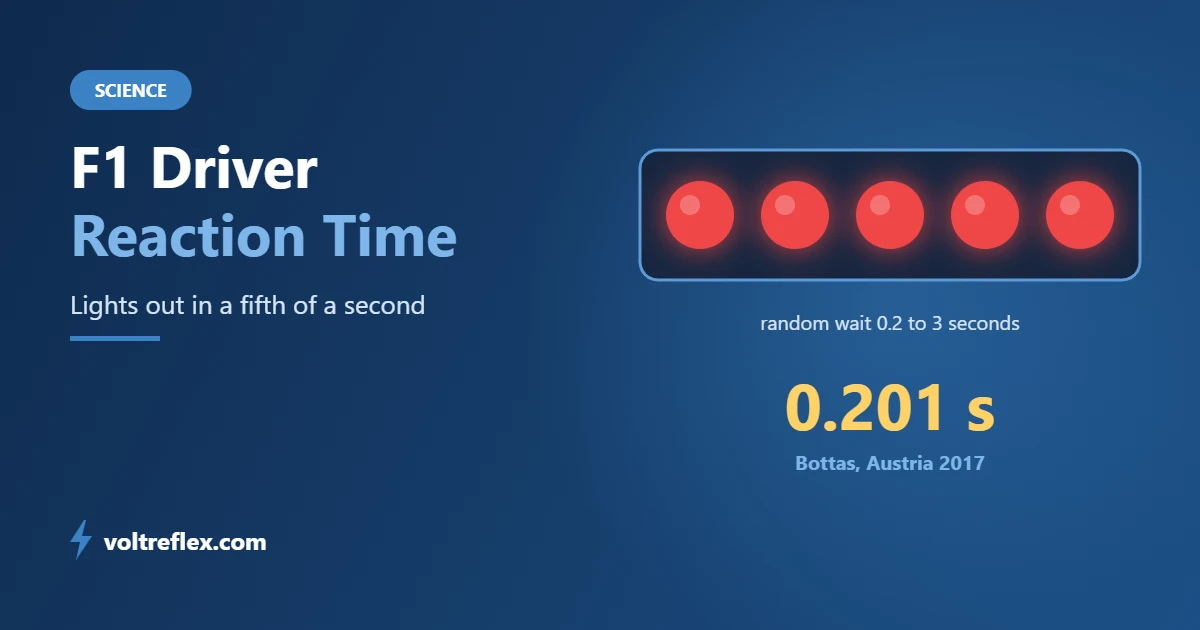
Lights out and away we go. In that moment, every driver on the grid tries to react faster than the rest.
A good start can win places before the first corner, so F1 driver reaction time gets a lot of attention. The real numbers are impressive, but they are not as superhuman as people often think.
Want to try your own lights out moment? Take the free VoltReflex reaction time test and see how you compare.
Key takeaways
- The start lights go out after a random wait of 0.2 to 3 seconds, so drivers cannot simply guess.
- At the 2017 Austrian Grand Prix, F1 data suggested Valtteri Bottas reacted in about 0.201 seconds.
- A small study found racing drivers were not faster on a choice reaction task than non racers.
- Focus, practice and car control matter as much as raw reaction speed.
The Short Answer
F1 drivers react to the start lights in roughly a fifth of a second when they get it right. The best known example is Bottas in Austria in 2017, at about 0.201 seconds.
That is quick, but it is in the same area as a rested, focused person on a good setup. We could not find an official average for all F1 drivers, so be careful with exact numbers you see online.
How an F1 Start Works
When the cars are on the grid, five red lights come on one by one on a gantry above the grid. Once all five are lit, the drivers wait.
Formula 1 explains that after a randomly chosen, computer controlled wait of between 0.2 and 3 seconds, all the lights go out at once. That is the signal to go.
The random pause is the key. It stops drivers from learning the rhythm and launching on a guess, which is the same idea used in good reaction tests.
Test yourself The VoltReflex test also uses a random delay before the screen changes. Do 20 rounds of the reaction time test and do not click until you see the change, just like waiting for lights out.
A Real Example, 0.201 Seconds
At the 2017 Austrian Grand Prix, Valtteri Bottas made what he called the start of his life from pole position. F1 data suggested he reacted within 0.201 seconds of the lights going out.
Rivals, including Sebastian Vettel, believed he had moved too early. The stewards investigated and ruled that any movement was within the allowed tolerance, so there was no penalty.
"A great F1 start sits right at the edge of what human reaction allows. Go any earlier and it starts to look like a guess."
How Jump Starts Are Caught
The FIA uses an automated detection system to spot cars moving before the start. A car that moves too early can be given a penalty.
For 2018 the FIA tightened the rules. Stewards can now give a penalty even when the system is not triggered, for example when a car is so far out of its grid spot that the system cannot read it properly.
Sprinting has a similar rule. In athletics, a start faster than 100 ms after the gun counts as a false start, because that is treated as too quick for a real reaction. See more in reaction time by sport.
Are F1 Drivers Born Faster
You might expect racing drivers to have freakishly fast reflexes. The research suggests something more interesting.
A 2017 study in PLOS ONE compared 7 racing drivers with 10 non racing drivers in a simulator. The racers set faster laps, steered more actively and took a better racing line. But on a choice reaction time task, there was no statistically significant difference between the groups.
The racers also looked around the track differently, with more head movement in corners. That points to trained skill, like knowing where to look and what to expect, rather than a faster nervous system. The study was small, so treat it as a clue, not the final word.
How You Compare
| Example | Time | Notes |
|---|---|---|
| Sprint false start limit | 100 ms | Faster than this counts as a false start |
| Bottas, Austria 2017 | About 201 ms | From F1 start data |
| Average adult in a lab study | 231 ms | Precise lab timing, 1,469 people |
| Most adults on an online test | 250 to 300 ms | Includes monitor, mouse and browser delay |
These numbers come from different setups, so they are not a perfect like for like comparison. Still, a focused score near 200 ms on VoltReflex puts you in very good company. Check the full ranges on our benchmarks page.
Want to get closer to an F1 start? Our guides on how to improve your reaction time and reaction time while driving are good next steps.
Frequently Asked Questions
What is the reaction time of an F1 driver?
Can F1 drivers guess when the lights go out?
Are F1 drivers born with faster reactions?
How is a jump start detected in F1?
How does my reaction time compare to an F1 driver?
The Bottom Line
F1 drivers can react to lights out in about a fifth of a second, as Bottas showed in Austria in 2017. The random wait of 0.2 to 3 seconds means they have to react, not guess.
Their real edge comes from training, focus and car control as much as raw speed. Take the VoltReflex test and see how close you can get to an F1 start.
VoltReflex results are for entertainment and self-benchmarking, not a medical diagnosis.
Sources
- Formula 1, Why race starts are so critical in F1
- Autosport, FIA explains why Bottas start was legal in Austrian Grand Prix
- Autosport, FIA tightens Formula 1 jump start rules for 2018
- van Leeuwen et al. (2017), Differences between racing and non racing drivers, a simulator study using eye tracking, via PubMed