"Drink more water, it will sharpen your reflexes." You have probably heard that before. Is it true?
The honest answer is more interesting. Dehydration and reaction time are linked, but not in the way most people expect.
Before reading on, take a quick VoltReflex reaction time test. Then try again after a long, hot day and compare.
Key takeaways
- A meta-analysis of 33 studies looked at dehydration and thinking skills.
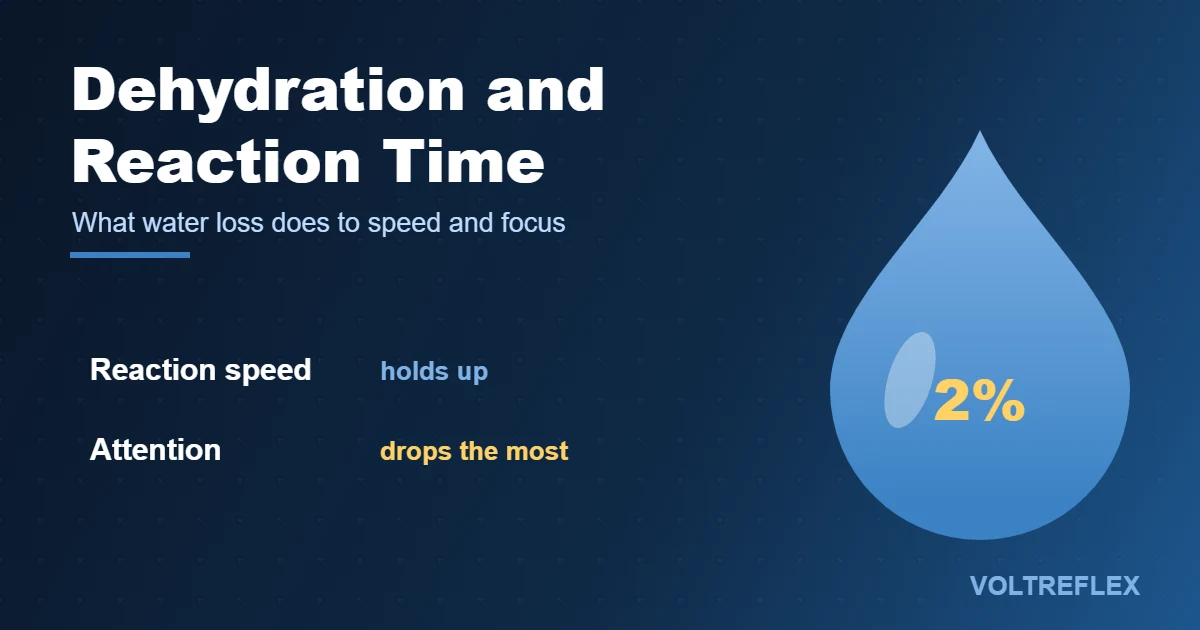
- Simple reaction time was the least affected skill.
- Attention and coordination suffered the most.
- Problems were clearer above 2 percent body mass loss.
What the Research Found
In 2018, researchers at Georgia Tech pooled the results of 33 studies with 413 people. The meta-analysis was published in Medicine and Science in Sports and Exercise.
Participants had lost between 1 and 6 percent of their body weight through fluid loss. The team then checked which mental skills changed.
The overall effect was small but real. And it was not spread evenly.
| Skill | Effect of dehydration |
|---|---|
| Attention | Largest drop |
| Motor coordination | Clear drop |
| Executive function | Smaller drop |
| Simple reaction time | No significant change |
"Your raw speed holds up. Your focus is what starts to slip."
The 2 Percent Line
The Georgia Tech team reported that the bigger problems showed up once people lost more than about 2 percent of their body mass.
For a 70 kg person, that is roughly 1.4 kg of fluid. You can lose that much during a long workout, a hot day outdoors or a sports match without drinking.
Below 2 percent, the effects were smaller. Above it, they roughly doubled.
Why Your Score Can Still Drop
If simple reaction time barely changes, why do some people score worse when thirsty?
Because a reaction test is not only about speed. It also needs you to stay focused through every round.
- A lapse in attention means one slow round that drags your average up.
- Early clicks happen more when focus is shaky.
- Choice tasks lean more on attention, so they suffer more than simple tests.
That last point matters for gamers. Real games are full of choices, not just one green light. Our choice vs simple reaction time guide explains the difference.
Spot the pattern Look at your round by round results, not just the average. A wide spread between your best and worst round usually points to focus, not raw speed.
Simple Hydration Habits
- Sip through the day rather than drinking a lot at once.
- Drink more in heat or when you sweat during exercise.
- Keep water at your desk during long gaming or study sessions.
- Check your urine colour. Pale yellow is a good sign.
Hydration is one piece of the puzzle. Sleep and caffeine usually matter more for a single test. See sleep and reaction time and caffeine and reaction time.
Do not overdo it Drinking huge amounts of water will not make you faster, and very large amounts in a short time can be harmful. Drink to thirst and adjust for heat and exercise.
Frequently Asked Questions
Does dehydration slow your reaction time?
How much dehydration affects your brain?
Why would my reaction test score drop if I am thirsty?
Can drinking water improve my reaction time?
How do I know if I am dehydrated?
Should gamers drink water during long sessions?
The Bottom Line
Dehydration does not slow simple reaction time much. It does hurt attention and coordination, especially after you lose more than 2 percent of your body weight in fluid.
So stay hydrated for steady focus, not for magic speed. Then test your reaction time and check your results against the benchmarks.
VoltReflex results are for entertainment and self-benchmarking, not a medical diagnosis.