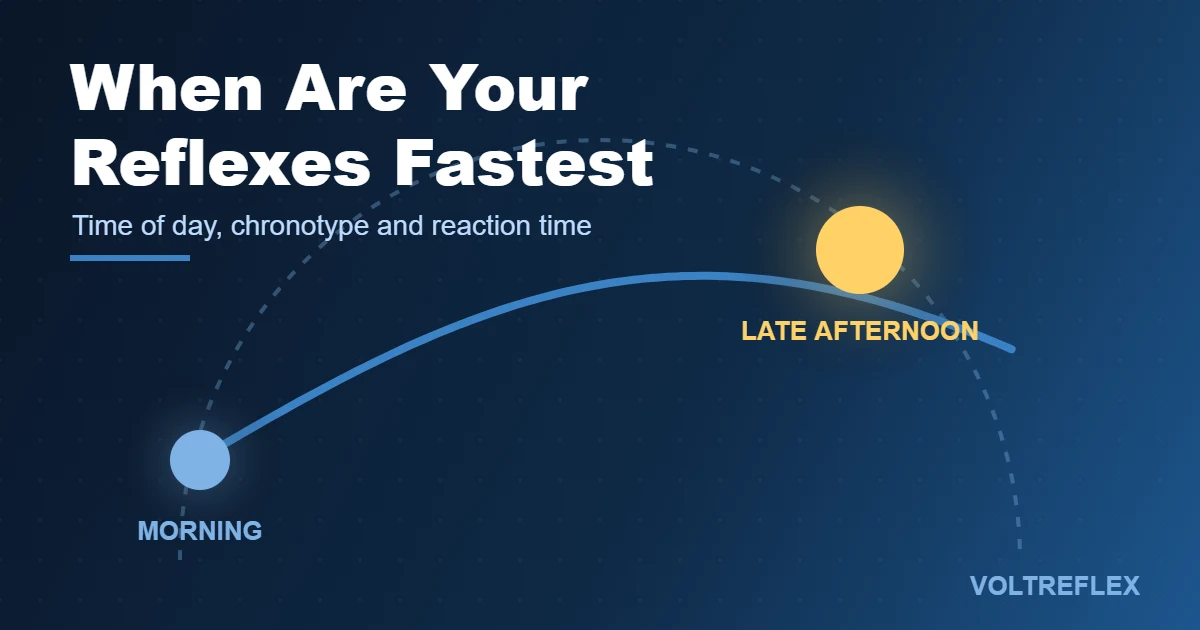
Ever noticed you score better on some days than others? Sometimes it is not the day. It is the hour.
The best time of day for reaction time is often later in the day, but your own body clock decides a lot. Here is what the research shows.
Try it yourself. Take the free VoltReflex reaction time test in the morning and again in the evening, then compare.
Key takeaways
- A 2023 review found reaction time and accuracy were often best in the evening.
- Time of day changed reaction time by 9 to 34 percent, depending on the test.
- Morning people and night owls peak at different times.
- The first stretch after waking is usually your slowest.
What the Research Says
A 2023 systematic review pulled together 11 studies that tested healthy adult men in the morning and evening.
Reaction time and accuracy were highest in the evening in many of them. The size of the difference ranged from 9 to 34 percent, depending on the task.
The authors were careful to say results were mixed. Some studies found no clear difference, and methods varied a lot. So treat evening as a good bet, not a rule.
| Time of day | What usually happens | Good for testing? |
|---|---|---|
| Just after waking | Grogginess from sleep inertia | Avoid |
| Late morning | Alertness building, good for morning types | Fine |
| Early afternoon | Many people feel a dip after lunch | Mixed |
| Late afternoon and evening | Often the best results in studies | Best bet |
| Late night | Tiredness builds up | Avoid |
"The clock on the wall matters. Your own body clock matters more."
Morning Person or Night Owl?
Your chronotype is whether you naturally prefer mornings or evenings. It shifts your peak.
A 2025 study of boxers tested reaction time at 9 am, 1 pm and 5 pm. Morning types got slower in the evening. Evening types did better in the evening than in the morning.
So if you are up early and full of energy, your best scores may come before lunch. If you come alive at night, test later.
Why You Are Slow After Waking
That foggy feeling after your alarm has a name, sleep inertia. A review in Nature and Science of Sleep explains that thinking and reacting are worse until it wears off.
It hits harder if you are short on sleep or wake at an odd hour. This is one reason a quick test right out of bed often gives your worst score.
For more on how sleep shapes your speed, see sleep deprivation and reaction time.
Test yourself For one week, take a 10 round reaction time test at three times of day. Note your averages and you will find your own peak window.
Can a Nap Help?
A short one can. The same sleep inertia review describes a study where a 10 minute nap improved performance straight away.
A 30 minute nap was different. Grogginess after waking meant the benefit took between 35 and 95 minutes to show, depending on the task.
- Keep naps short if you need to perform soon after.
- Give yourself time to wake up properly after a longer nap.
- Add light movement, like our reaction time warm-up, before you play.
How to Use This
- For tracking progress, test at the same time every day so the hour does not skew your results.
- For a personal best, try your natural peak, often late afternoon or evening.
- For ranked games, schedule important matches for your sharpest window when you can.
- Avoid the extremes, right after waking and late at night.
Other things move your score too. Read why is my reaction time slow and caffeine and reaction time.
Do not chase a number at midnight Staying up late to beat your best score usually backfires. Tiredness slows you down far more than the time of day helps.
Frequently Asked Questions
What time of day is reaction time fastest?
How much does reaction time change during the day?
Why am I slow right after waking up?
Does being a morning or night person matter?
Does a nap improve reaction time?
When should I take the VoltReflex test?
The Bottom Line
The best time of day for reaction time is often late afternoon or evening, but your chronotype can shift that. The first stretch after waking is usually your slowest.
Find your own peak, then test your reaction time at the same time each day to track real progress against the benchmarks.
VoltReflex results are for entertainment and self-benchmarking, not a medical diagnosis.